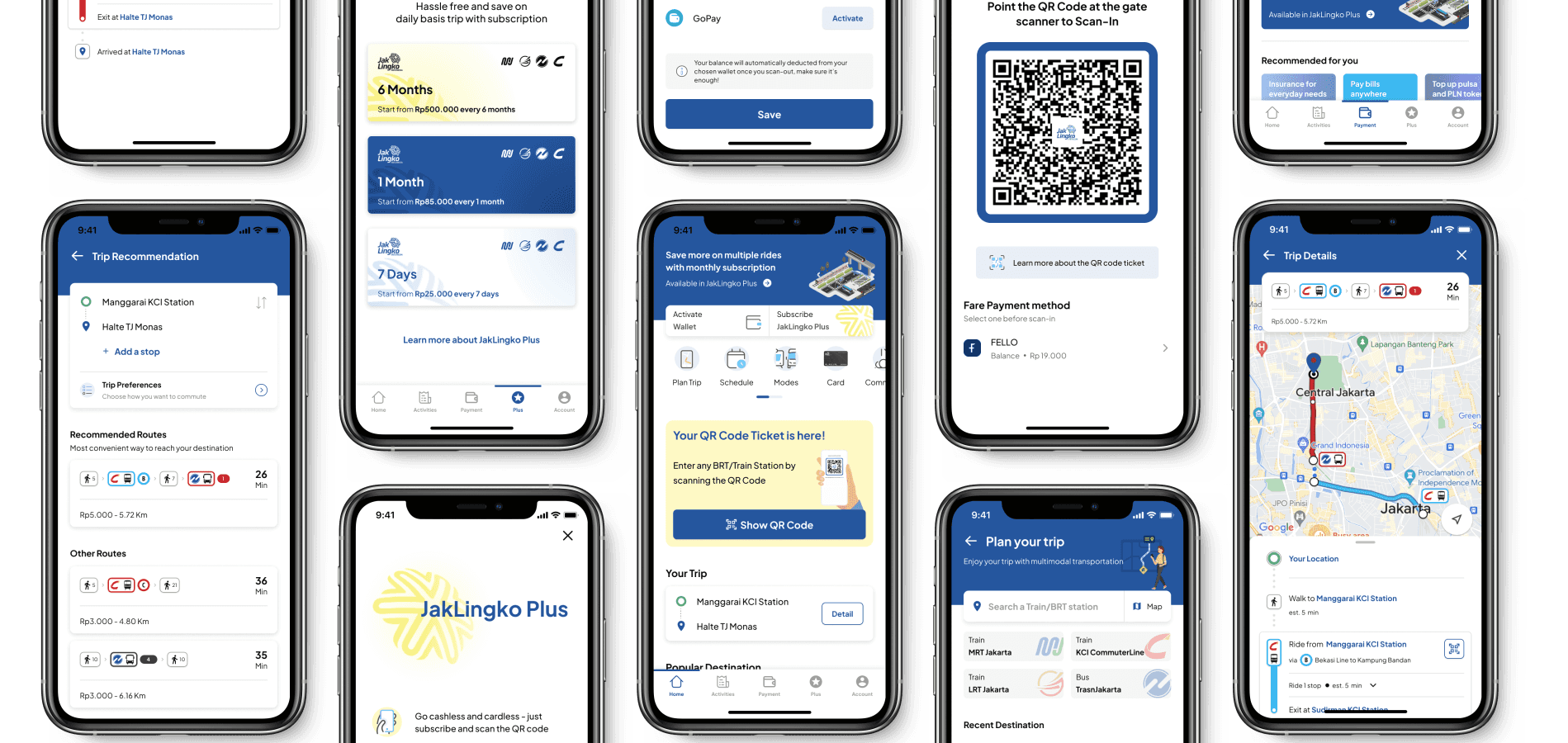
Imagining Fresher Commuting Experience with JakLingko app
Refined journey on Jakarta’s Mobility-as-a-Service app.
Jun - Aug 2022
Mobile App
Personal Project
10 min read
How I landed a Product Designer role by presenting a mock-up project and then have the opportunity to work on a real project that is similar to my mock-up project? This is the story from my experience, where I exposed myself to an Mobility-as-a-Service (MaaS) experience and an end-to-end product design process.
Overview
Jakartans are getting a better public transportation system. Jaklingko, a public transport integration program has released an app with Mobility-as-a-Service (MaaS) concept to support end-to-end trip planning, and integrate payment services between modes of public transportations in Indonesia’s capital city, Jakarta. As someone who frequently uses public transportation, I decided to try out the app out of curiosity and to see how I can improve it.
Objective
Other than for me to practice, the intention of this project is to enhance JakLingko by generating ideas for new features and improving UX, visuals, and structural hierarchy. The goal is to create a seamless experience that integrates the digital platform with real-world situations, resulting in an improved overall mobility experience.
What I did
Landscape Analysis; Auditing the existing app with real user
Conducted field research; interview real users
Concept exploration; new trip and ticketing concept
Visual exploration
Built prototype and interaction
Validate concept with UT
Getting Started
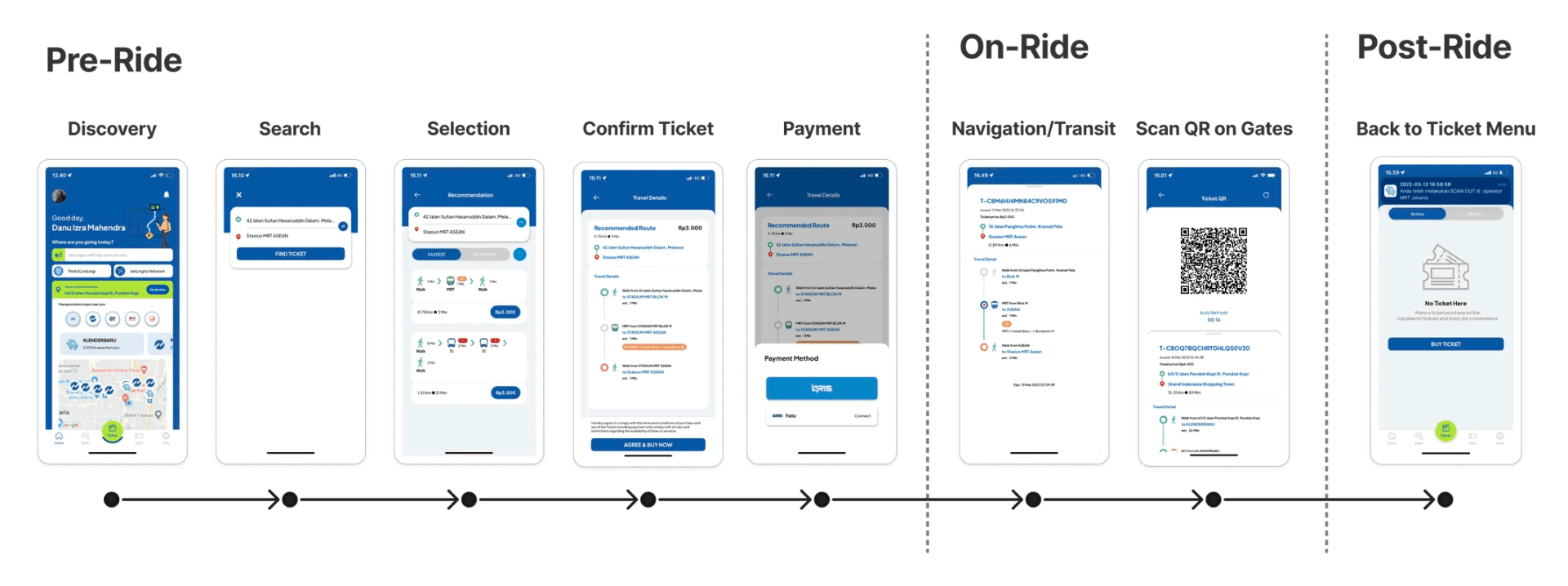
I found that it implement a one-way ticket system. As I refer in the image below, this services used a QR code scan as a payment-on-gate method in exchange for the card function which is the favorite and practical payment method for public transportation users nowadays in Jakarta.
Insight from the field
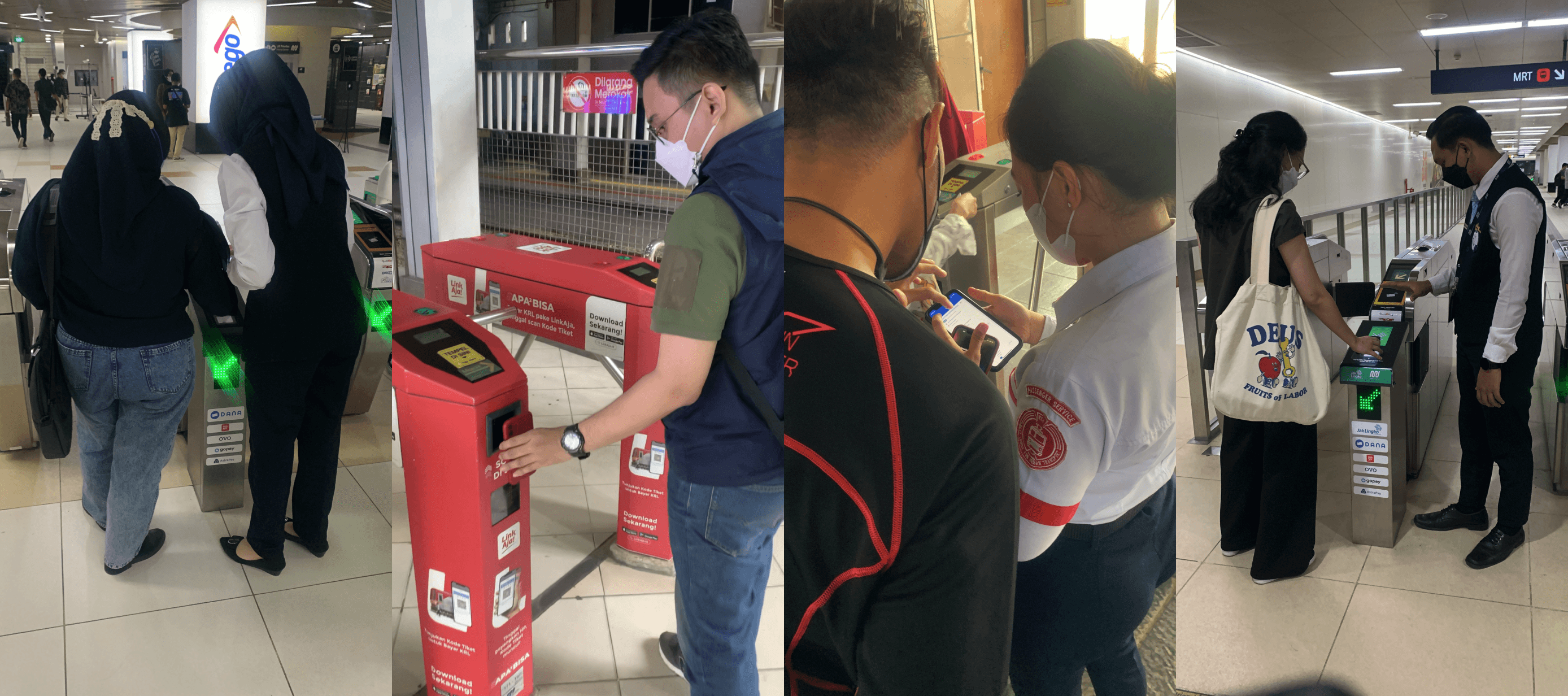
I went to seek out deeper stories and tested the existing JakLingko app with 4 participants by commuting with them. My goals were to understand the challenges user faced when commuting with JakLingko.
And the problems are..
1
Flexibility in Commuting
I started to meet with the participant at different times to try the app. During the test, I suggested them to do a happy path task where user can complete a journey based on their bought ticket
The normal, happy path of JakLingko could be like this:
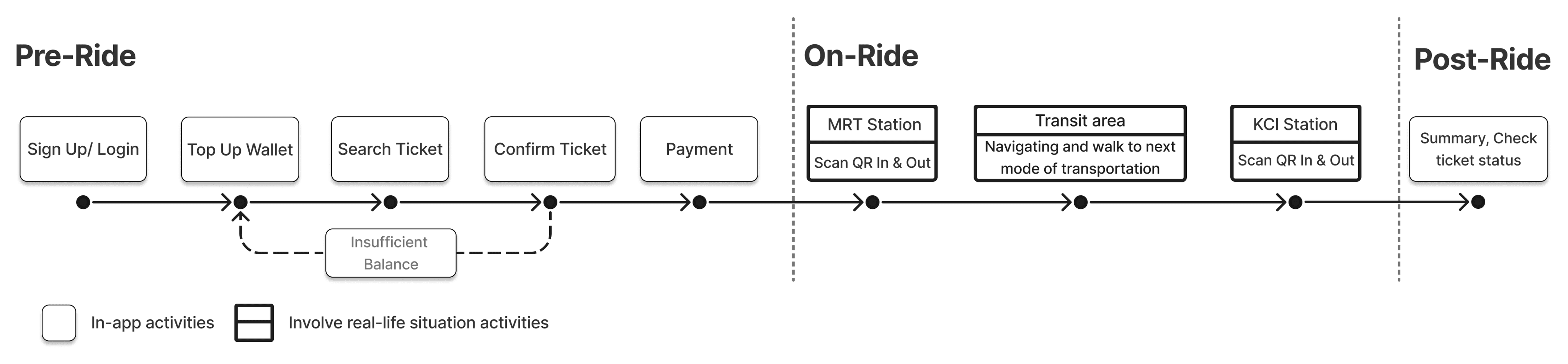
If user goes according to the purchased ticket, it won’t have a problem.
Second, I test Jaklingko on Flexible Path which I conducted after the Happy Path. In this path, I want to validate my point of hypothesis regarding Jaklingko’s ticketing system flexibility, which also could be refer as an unhappy path/negative state on the app.
The case for Flexible Path (Unhappy Path) could be like this :
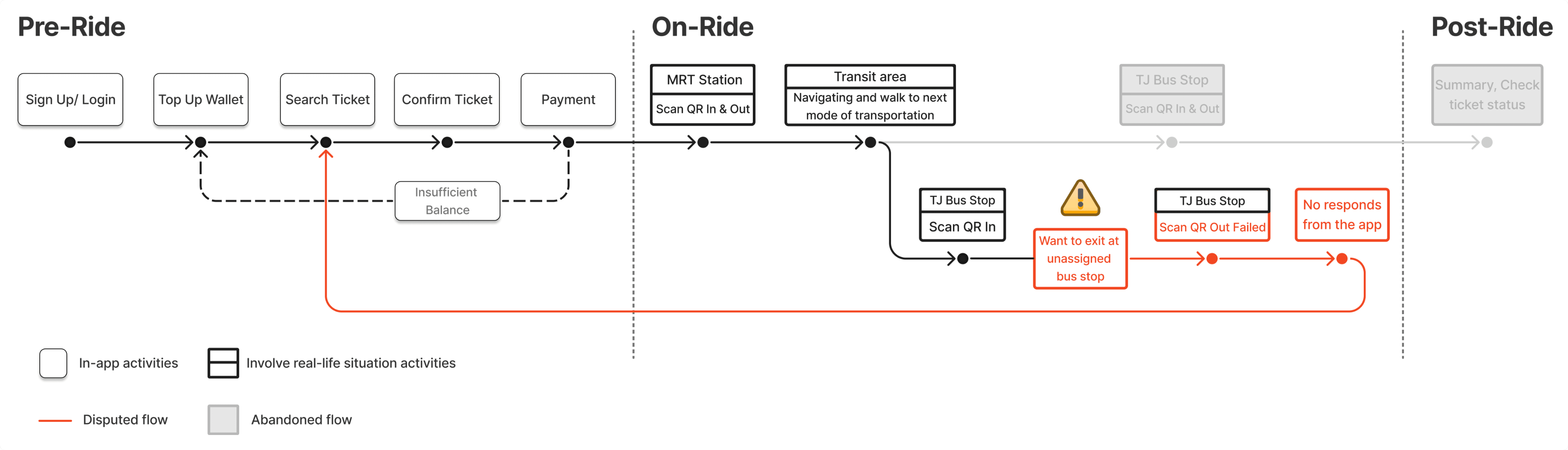
If user want to get out at the unassigned station, the QR code are unreadable by the station gate that not match with the purchased ticket because it is a one-way ticket, so the QR code provided are fixed to the assigned station.
I documented my attempt to getting out of the unassigned station
2
Limited Payment Method
Based on the tweet of some early user, the in-app payment doesn’t works seamlessly as in the flow and the payment options. Some of them also compare it with other app that have a better payment experience than JakLingko
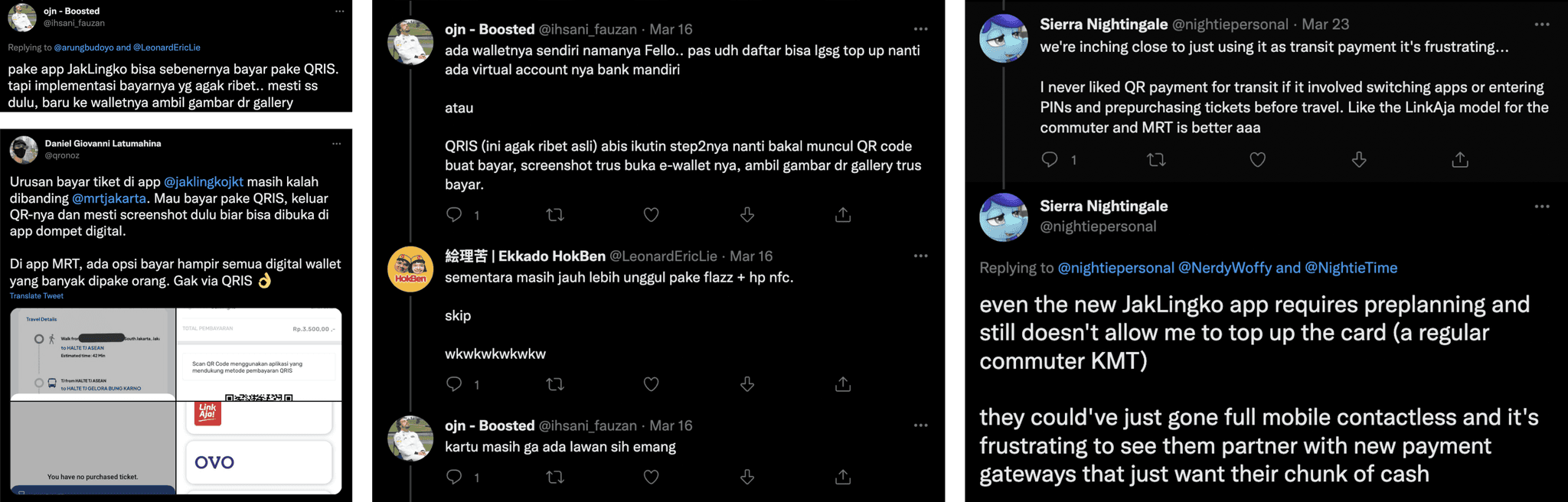
JakLingko only provides 2 payment channel; FELLO and QRIS. User are struggling when doing top up and payment for the first time.
Check the video of Jaklingko's limited payment method
3
No Benefit in using the app
From the interview, users would still chose physical card as the main payment method for using public transportation.
Card, especially the one from bank, is already my go-to payment method for all type of public transportation modes
I don't see the point of why should I use the app
I only use public transportation app when I want to try, or sometimes when my card is lost/fails
Public transportation app, especially JakLingko is consider as a complementary, which only used when they curious or they just want to try. This is because users don’t feel any benefits when using JakLingko app.
4
Company’s
Intention
The last important thing is Jaklingko itself as a company wanted to bring more values to the product, in order to people of Jakarta to use public transportation more
Migrate the existing physical card-centric ticketing payment to a Integrated fare system and Account Based Ticketing (ABT)
Getting more user to use Jaklingko app by giving more valuable and affordable options of payment/ticketing system
As JakLingko app is the product in still adoption phase, I also try to collect intentions from the company, PT JakLingko so that we can align with the company’s vision. Luckily, the intentions I found are somehow related to the problems I identified.
Brainstorming the experience
If I summarized my findings, JakLingko App have poor flexibility with its overall journey. The un-flexible journey consist of; inefficient one-way ticketing system, unfamiliar and complicated payment method, and lack of benefits from using the app. Unnecessary efforts arise when the user commute with JakLingko, which leads to frustration and wasted time.
I conclude my findings and user’s frustration as a User Journey Map
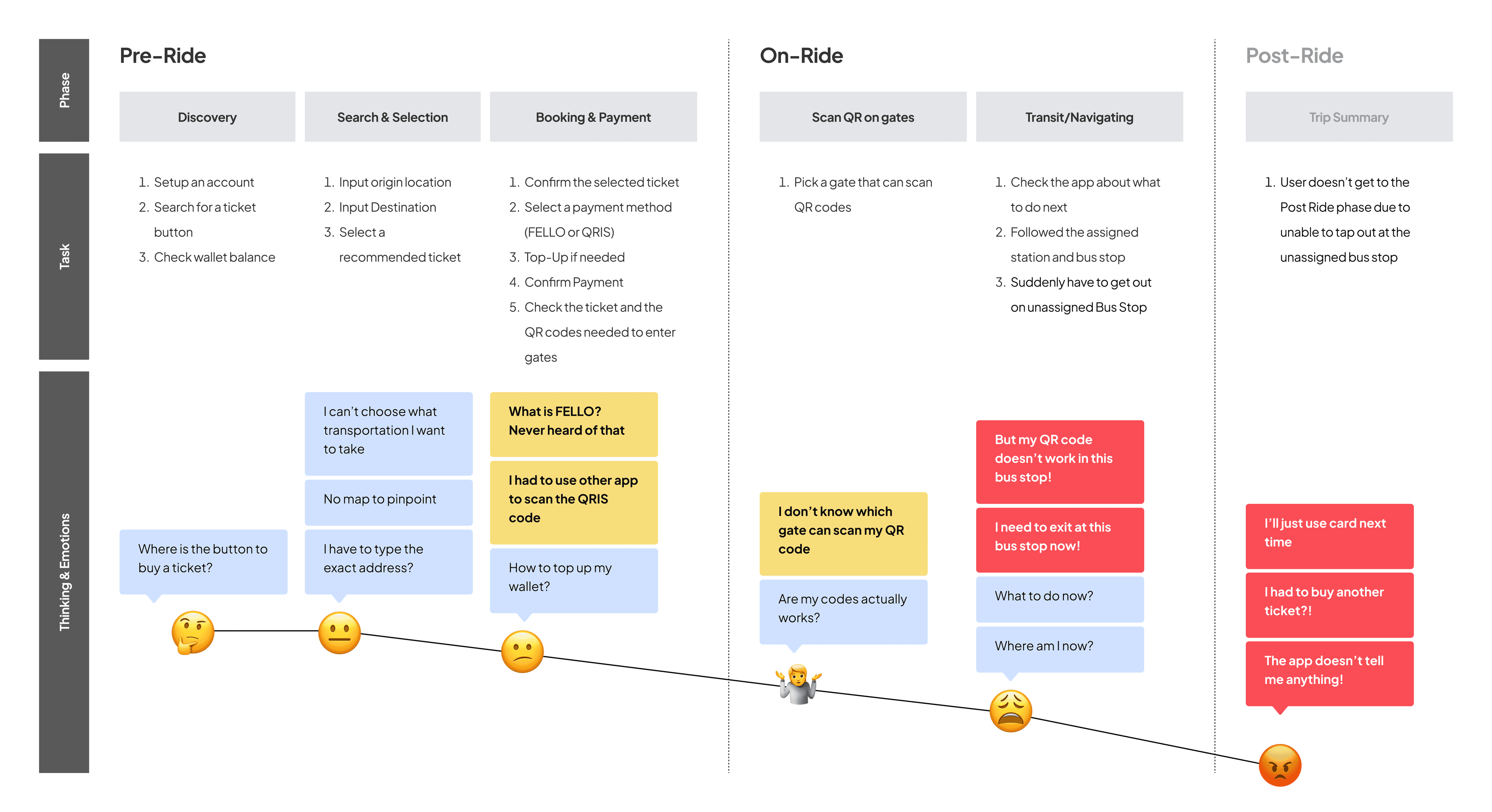
This begged some questions…
how might we provide a more valuable and affordable options of commuting so the user feel more beneficial with using JakLingko app?
how might we help commuter by forming a new, better flow of journey and commuting with JakLingko app?
First, I can focus on identifying design opportunities that can be done based on the pain points and company intentions
Opportunities on Ticketing System
No more single buy ticket. Develop a payment system where commuters can scan QR code directly with connected wallet
Separate the ticketing and trip planning feature. Make the trip planning flow optional.
Pain Points & Intentions
Have to buy ticket repeatedly because it only provide one-way ticket
Using app in general does not give more benefit than using a physical card
Company wants to migrate the existing card-centric ticketing payment to a Integrated fares sytem and Account based ticketing
Opportunities on Benefits
Develop an Account-based monthly/weekly subscription for cheaper fare
Keep subscription optional and separated with a registration up-front
Pain Points & Intentions
Have to buy ticket repeatedly because it only provide one-way ticket
Using app in general does not give more benefit than using a physical card
Company wants to migrate the existing card-centric ticketing payment to a Integrated fares sytem and Account based ticketing
Opportunities on Payment Method
Add more digital payment channels and merchant
Pain Points & Intentions
Have to buy ticket repeatedly because it only provide one-way ticket
Using app in general does not give more benefit than using a physical card
Company wants to migrate the existing card-centric ticketing payment to a Integrated fares sytem and Account based ticketing
Second, I can summarized the opportunities above into 3 cases so I can analyze each of them to put into the new design flow
New Flow of Ticketing & Riding Process
As the main function, the new Ticketing flow is directly connected to homepage and the payment method. The riding process doesn’t require a pre-transaction, because the QR code is available anytime.
New Trip Planning Process
Trip planning is optional and separated from the ticketing system. But it is still directly connected to homepage
JakLingko Plus & Subscription
A timely subscription features that provide an unlimited ticket to ride public transportations
This is how 3 cases were utilized to refine the new flow.
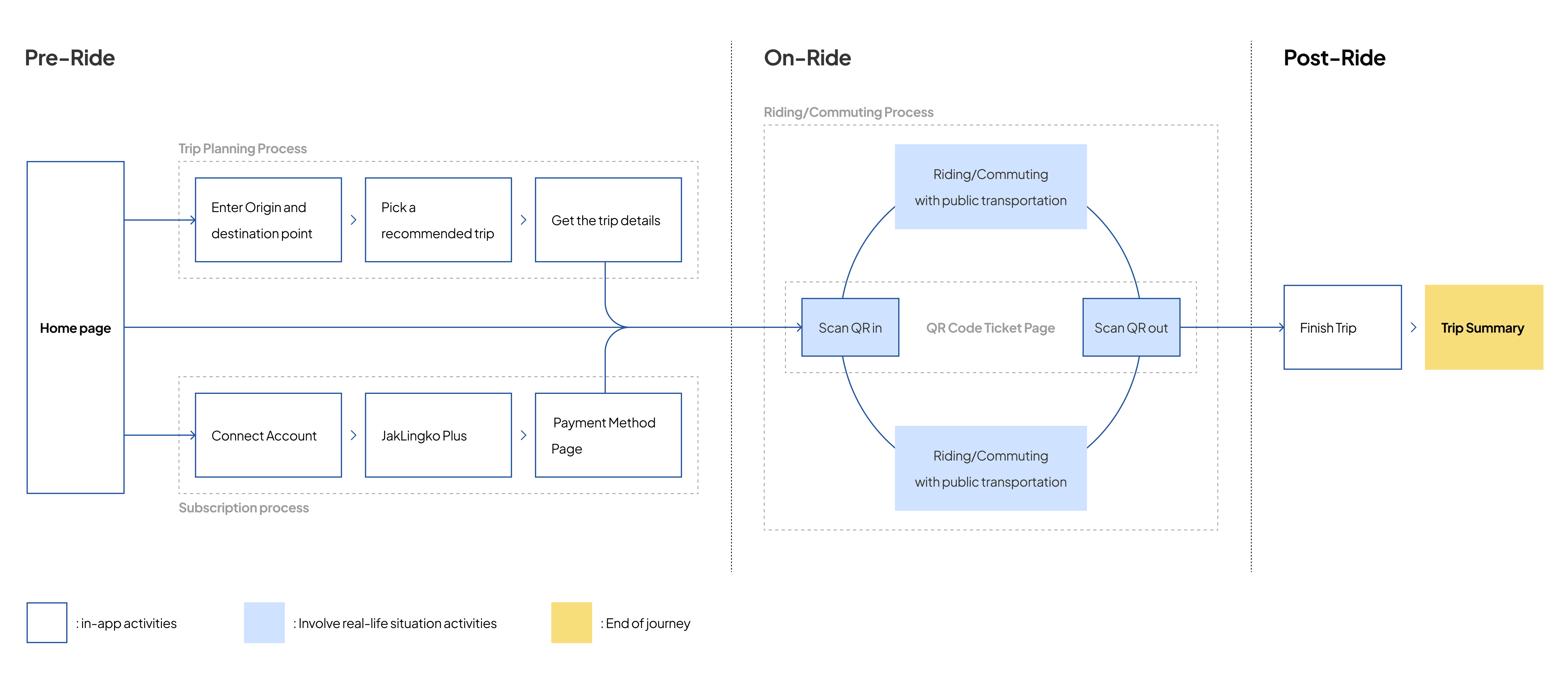
The QR code ticket page are included in Riding/Commuting process (In-Ride phase) to focus on JakLingko main function as a ticket to commuting with public transportation. Meanwhile Trip Planning and Payment method are separated in Pre-Ride phase so it can be done before Riding/Commuting process.
Testing the Solution
I approached 4 participants to a usability testing (via Maze), including some of the participants that helped me with the field research before so they can directly compare to the original design. I asked them to do 3 various tasks according to each flow; Ticketing, Trip Planning and Buying Subscription, then followed by scoring and some questions to gain deeper insights.
Testing Insights
The subscription feature would be useful for daily user
The testings results shows that the new ticketing system is much more easy to use without one-way ticket and various payment method
First time user may get confuse by the overall ticketing system
Detailed element like illustration, photo or any graphic could help in a more engaging interaction.
Subscription feature may need more iteration when utilizing it for Account-Based Ticketing, It might need a registration first.
Solutions
New Commuting Journey with Jaklingko App
Thanks to the unified fare system, No more stuck on a single one-way ticket, scan-in and out on any station, any modes you want, as easy as using physical card.
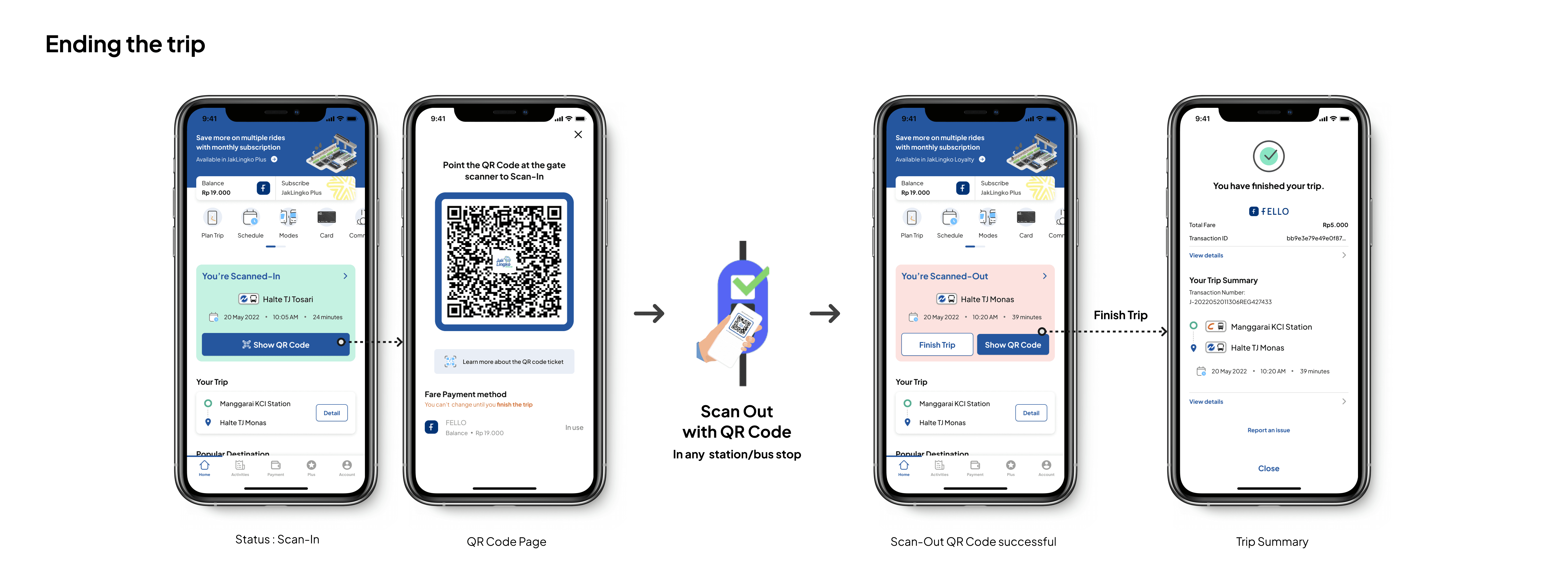
Use the QR code ticket as easy as using physical card.Start and finish the trip anytime you want, the balance will automatically deducted base on user’s time in commuting until the trip finished
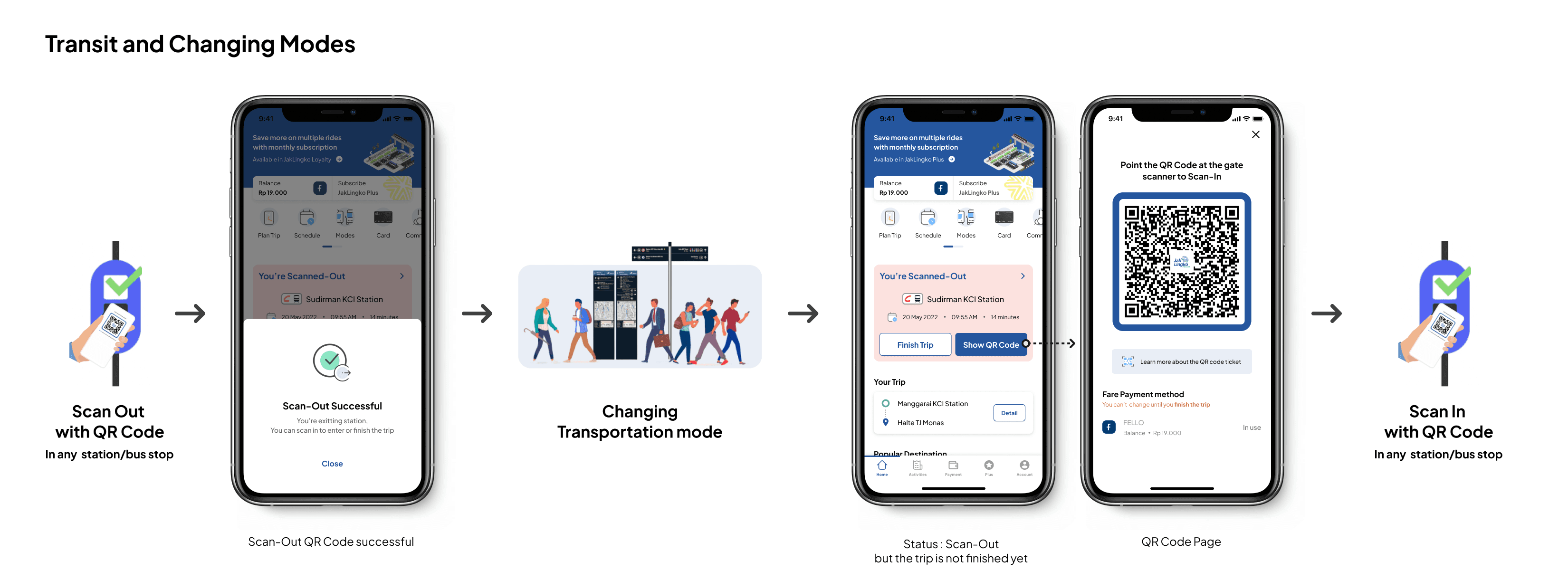
Below is the refined journey when commuting with JakLingko App;
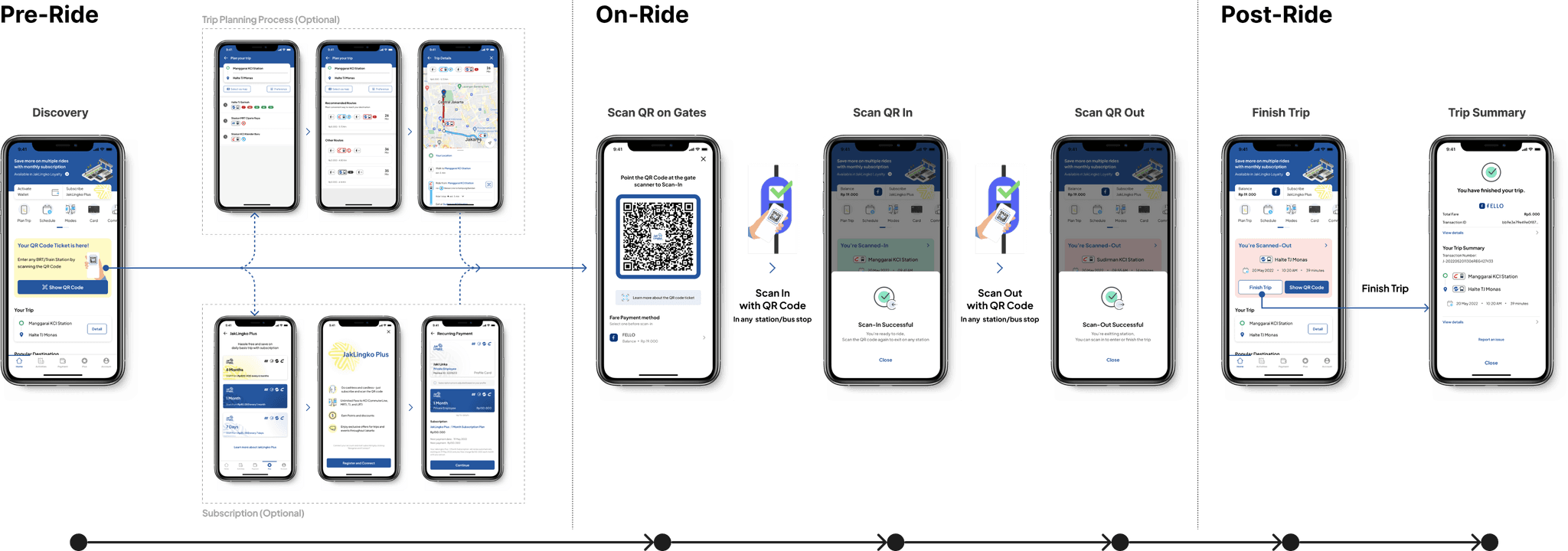
Scan In and Out directly, Anywhere you want
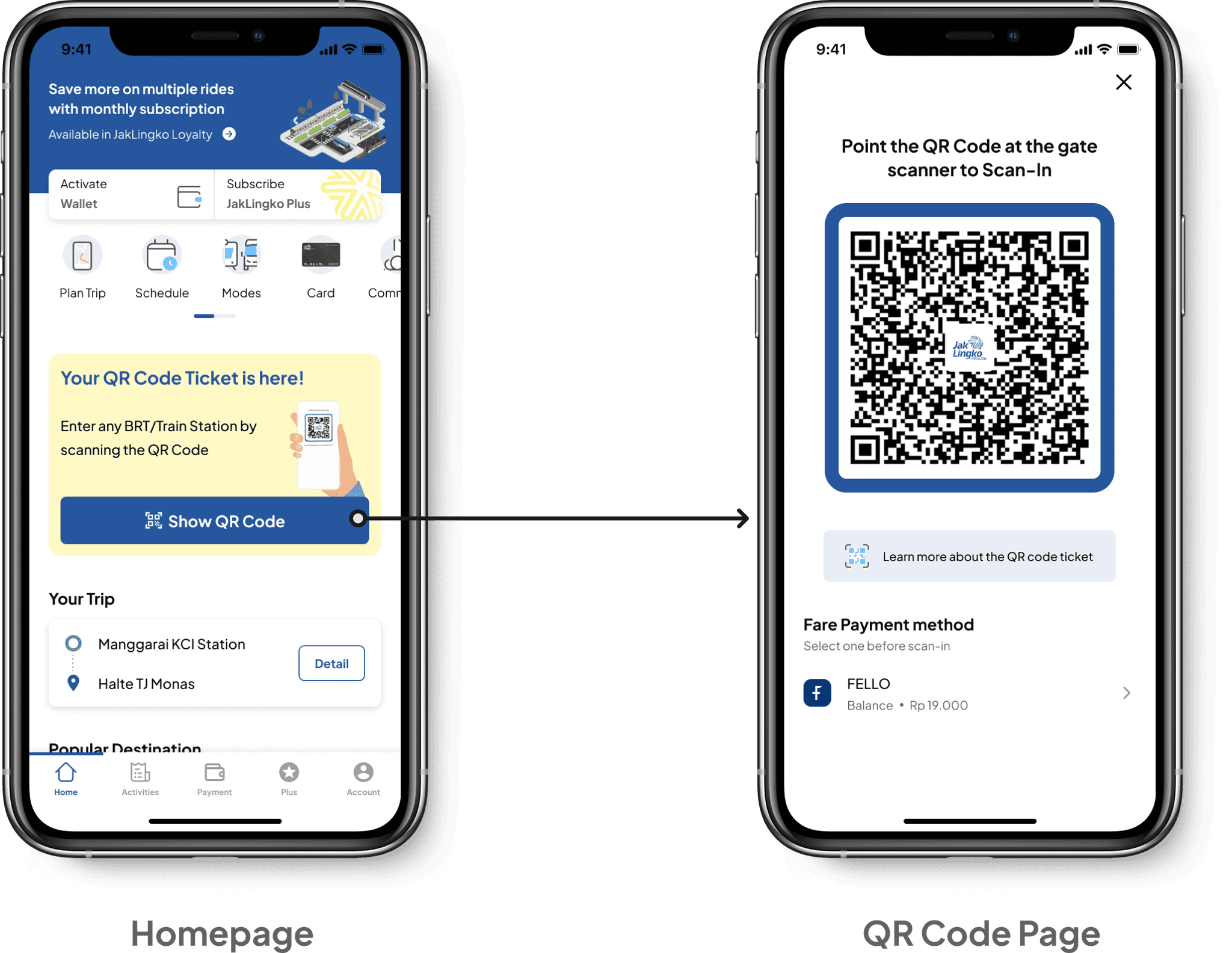
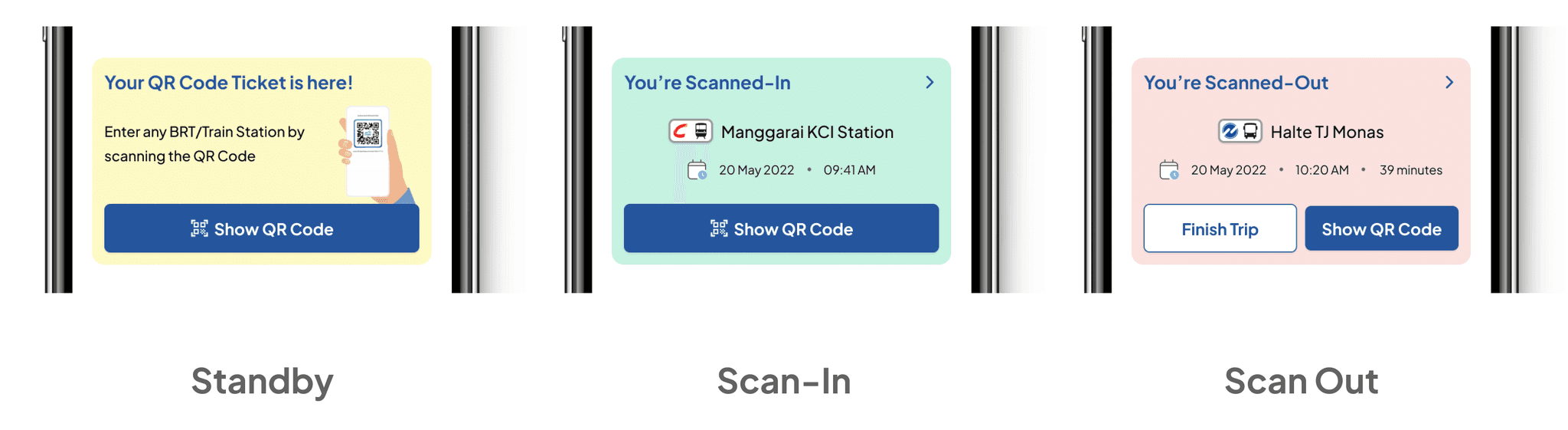
User can access the QR code to enter a station directly from this card.
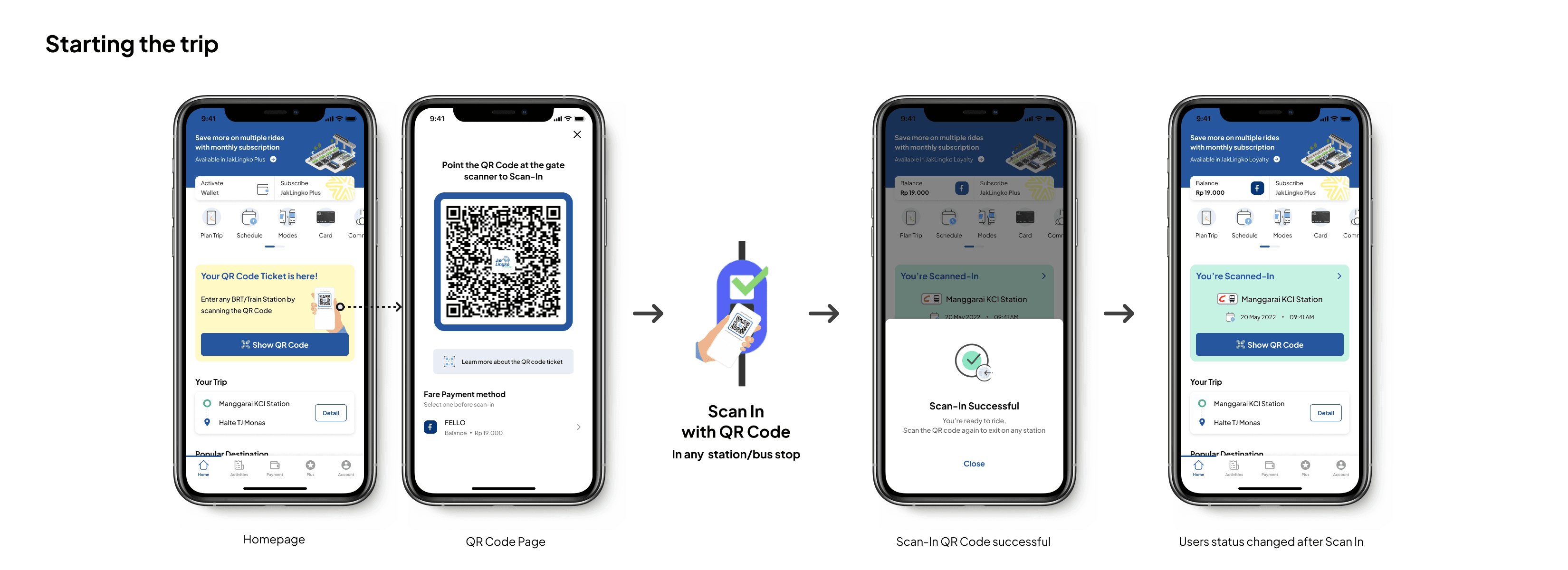
Once you scan in or out with your QR code on the station gate, your status will change
What I learned:
This solution is the answer to the main problem which is the flexibility in the ticketing system. Based on UT, this changes are the one that users really appreciate rather than the one-way ticket on the original design. Because it is a “walk-in” services without any in-app trip planning required like the original design implemented.

Here are the detailed breakdown on how the scan between station works on a single journey;
Improved Navigation
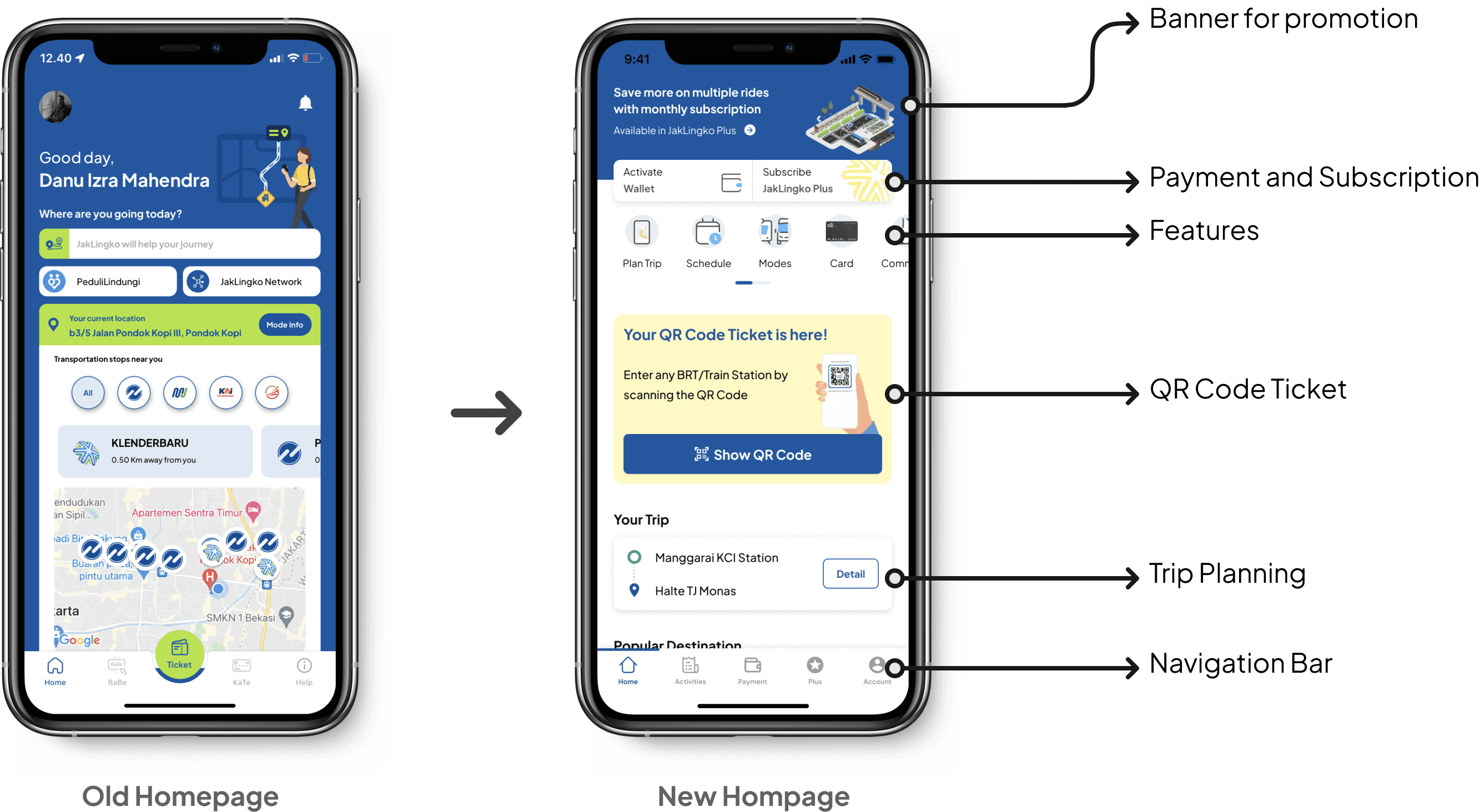
I refined the whole homepage to have a new architecture of information that could provide all the important features and information in the new design.
What I learned:
Based on the UT, user are pleased that all information in homepage are now easier to navigate and to scan thoroughly. Especially the scan card and button where user can easily find because of its center position.
More Flexible Trip Planning
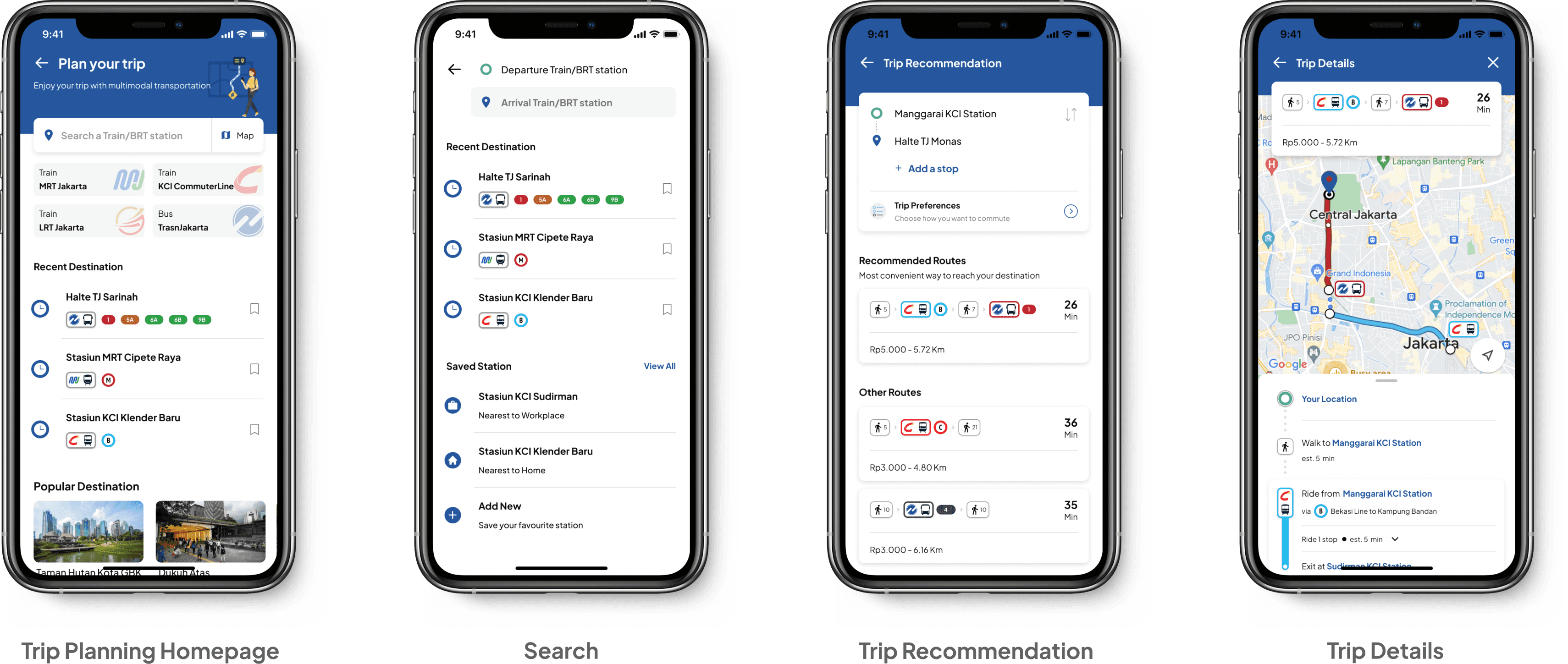
Plan the trip only when needed. It is not tied to any specific ticket or station anymore, but it stays here whenever the users need it.
What I learned:
This is now an optional feature wherever the users go. Even though user already planned the trip, user can bail out of it anytime anywhere. From the interview and testing, users are more comfortable with navigation app like google maps that gives preferences without forcing the user to stick with it. In this case, I try to focus on giving information about the trip and which stations to go.

Inclusive and Organized Payment
The new payment methods are now integrate the e-wallet to the QR code. Now it have more variety of e-wallet and also subscription. User can also top up instantly without using other app.
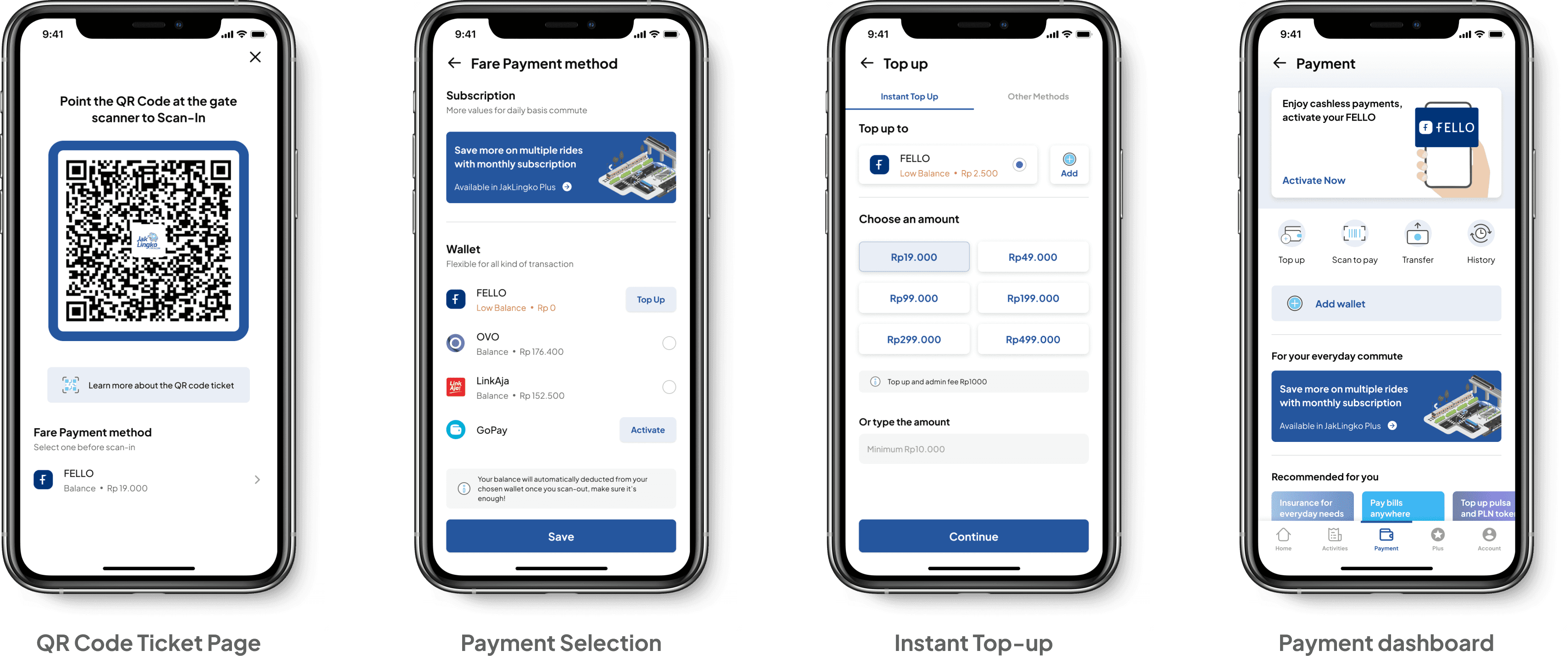
What I learned:
From the UT and interviews, without any trouble of setting up new e-wallet or top-up, this one simple solution could fulfill their preferences of cashless payment options.
Balancing User Needs and Company's Intention
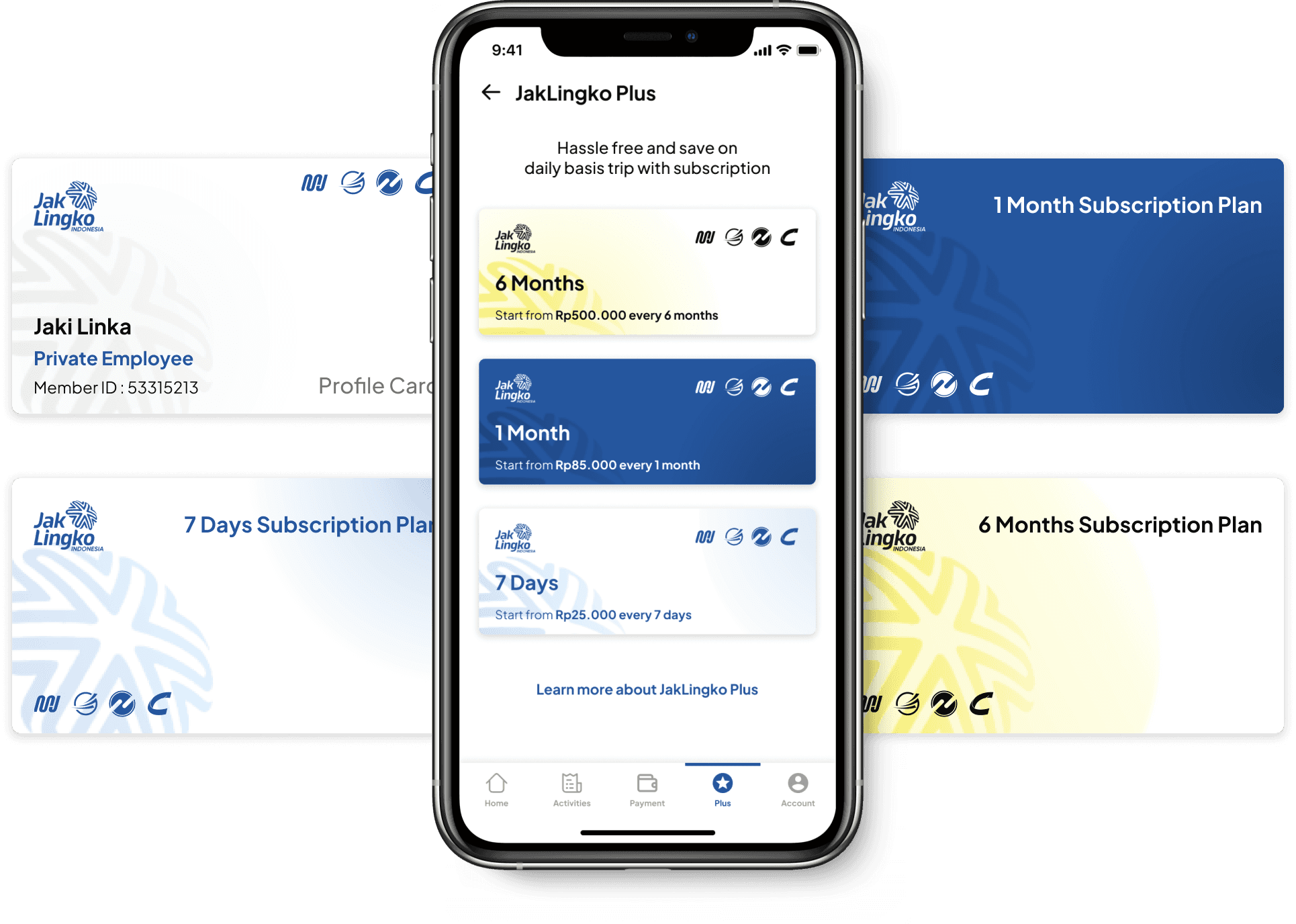
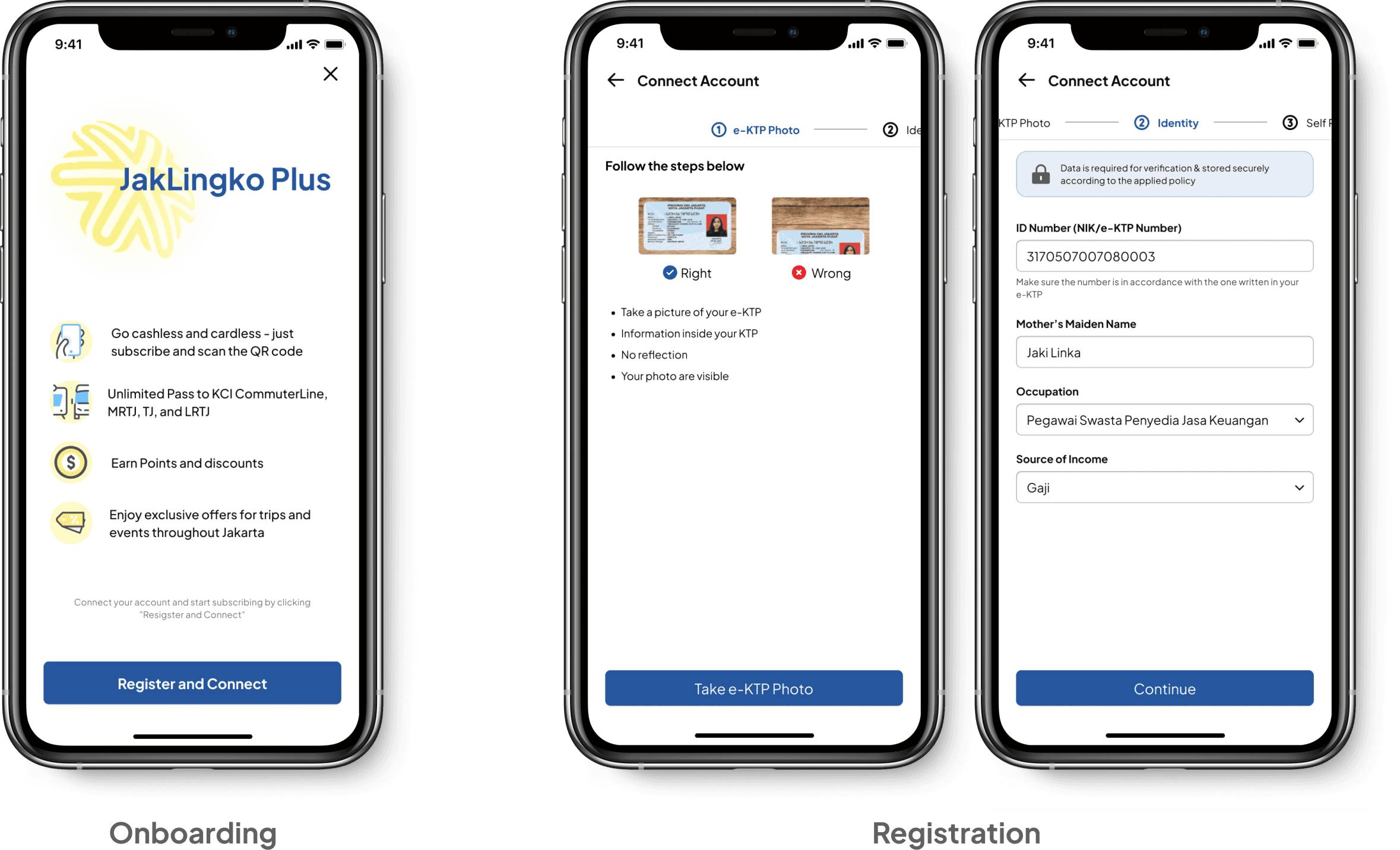
Connect user’s account to JakLingko Plus and get special price for based on user’s profile. Utilizing the account based ticketing that has been planned by PT. JakLingko to make user commit on a monthly/weekly subscription.

Connect user’s account to JakLingko Plus by filling a simple registration form, ID photos and self portrait. Get your profile card and the price determined for your profile.
After that, purchase subscription from JakLingko Plus menu. Thanks to implemented account based ticketing (ABT), subscription available based on its duration and its compatibility with user’s connected account and profile.
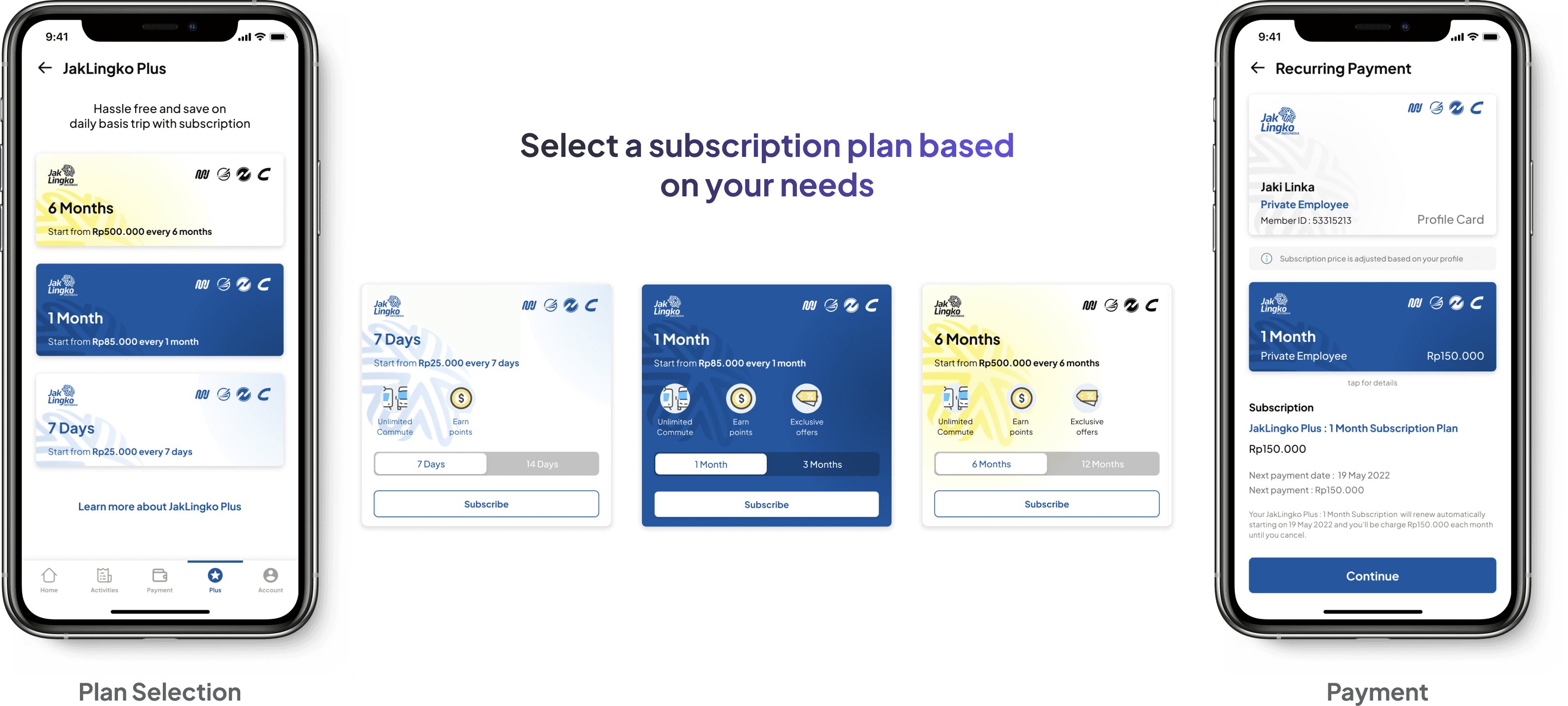
What I learned:
From the testing, user thinks that subscription feature would really useful for daily users who uses public transportation everyday which could be the benefit of using this app compared to physical card. Though the selection of benefits from the features can be added in the future for wider type of user.

Results
4 out of 5 Participants gave score above 8/10 for the final solution/redesign after they did the testing and would recommend the design to others if it’s implemented. Compared to the original design, 5 out of 5 participants gave score below 8/10 and demanded a better design.
5 out of 5 participants also agreed that they would want to replace the physical card if this new solution implemented.
Learnings and What’s Next
Working on a mock-up project are tricky to validate because there are many decision are made base on assumption. In this case for Jaklingko, I can’t really confirm what is PT Jaklingko (the company) planning and and what are the limitation of the app itself. If I have more time, I would’ve ask around about its system limitation, what is applicable and what is not.
It also what makes me think the prototype testing is a little bit tricky, I can’t emulate the 100% real situation of commuting like Scan-In and Scan-Out. The product needs to be live to entirely make sure this system works well.
There are so many opportunities to explore from this JakLingko app. Features such as real-time schedule and location for transportation is also a good design opportunities to explore. But what I designed here are the most important for JakLingko as a new choice of payment method other than physical card.
The research process itself is a long journey, as a beginner, I couldn’t prioritize what kind of research and what type of data that needed to make effective research, that’s why I used many research methods. But I enjoy the process of the research in public transportation industry, It forces me to consider not just the in-app situation, but also the on-ground situation on when user commuting.
Thank you for reading up to this point!
Luckily, this project helped me to get an opportunity as a product designer intern and work with the Jaklingko team. See more details on the next case study