OZONE
Designing a behavior-change system for Singapore's car-lite future
OZONE is a proof-of-concept mobility app built by Nippon Koei after winning the Jurong Lake District Innovation Challenge, an open competition run by the Singapore government to find new ways to shift daily commutes away from private vehicles. I joined through SixtyTwo as the sole Product Designer to turn Nippon Koei's winning proposal into a working digital experience in four weeks.
Year
2024 – 4 weeks
Role
Product Designer
Stage
Proof of Concept
Credit
SixtyTwo
Client
Nippon Koei, LTA Singapore, SMRT
CONTEXT
Singapore needs 85% of all trips in Jurong Lake District to be Walk-Cycle-Ride (car-lite) by 2035.
While JLD already has MRT lines, bus services, and rapid development underway, infrastructure alone isn't attractive enough to shift long-time drivers away from their cars. Car owners and frequent drivers with established routines simply don't perceive public transport as a viable alternative.
SMRT posed a challenge through the Jurong Lake District Innovation Challenge:
“How might we encourage drivers to go car-lite and promote more Walk-Cycle-Ride modes of transport?”
Nippon Koei won the challenge with a concept for a personalised journey planner — an app that would surface the benefits of car-lite options at the right moment in a driver's day.
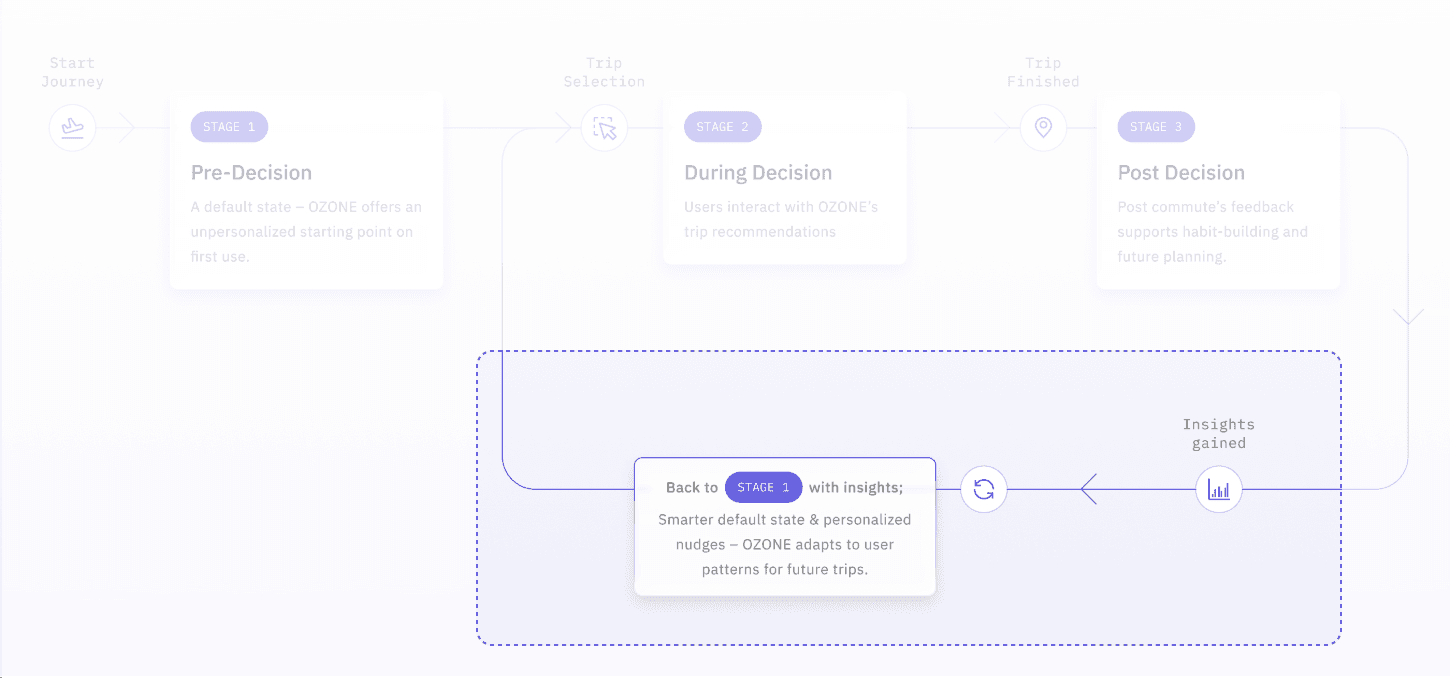
But existing journey planners in Singapore like Google Maps, Apple Maps, and Waze weren't setting a strong precedent. They follow the user's initial behavior without any effort to shift it: by the time a driver types a destination, they've already leaned towards driving. The moment that matters for behavior change happens before and after that — and that is where OZONE's opportunity comes in.
[↑] How ozone opportunity comes fit in the user journey
click to switch
RESEARCH
Understanding Behavioral Design
Before building the system, I found that behavioral nudge theories suggest people make better choices when the environment is designed around how they actually decide — by reshaping how options are presented, not restricting them.
I mapped these principles against the three opportunity moments from the commute loop — looking at how real products apply them, and what each gap demanded as a response.
INSIGHT 1
Smart defaults change behavior before users actively choose.
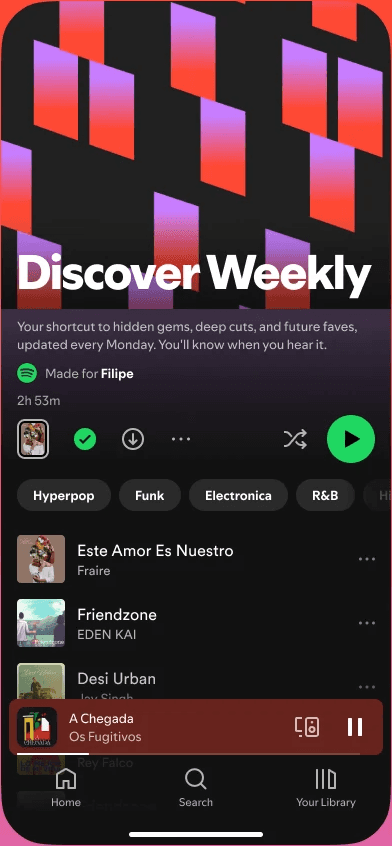
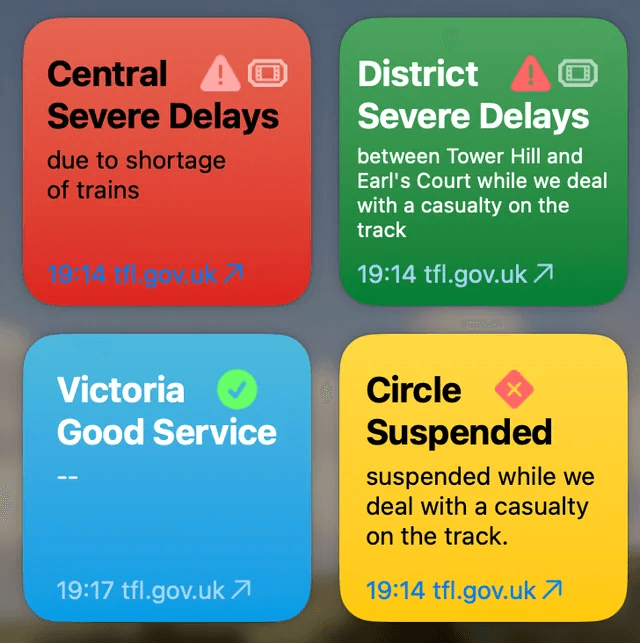
Spotify's Discover Weekly surfaces a personalised recommendation before the user searches.
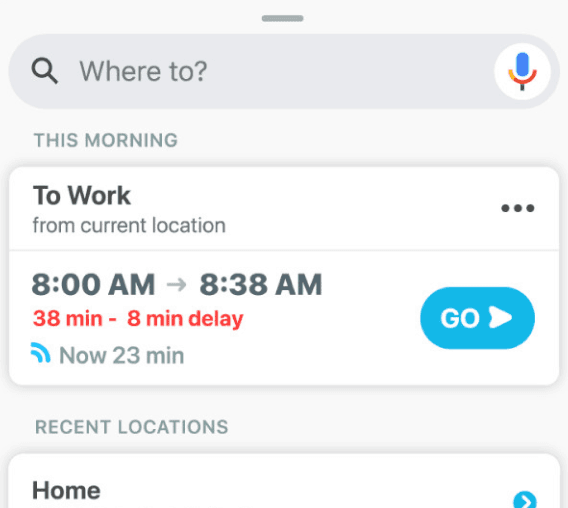
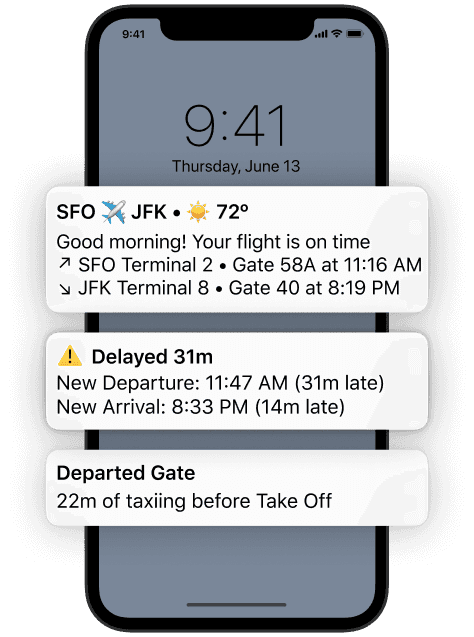
The same principle Waze applies with its proactive "To Work" homepage card, and iOS with timely notifications that arrive before you ask.
But no journey planner uses this to default to the most sustainable route.
EAST Framework + Nudge
Insight 2
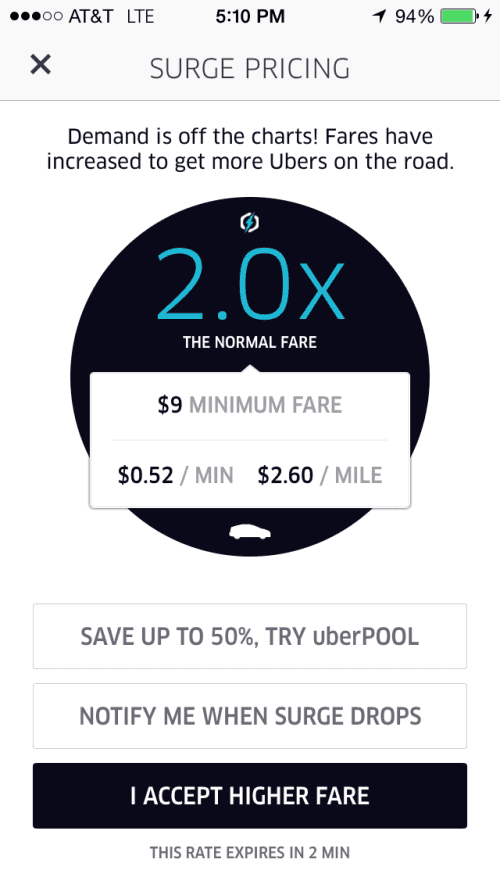
Framing a comparison changes which option gets chosen.
Uber visually frames surge pricing to shift user behavior toward cheaper times.
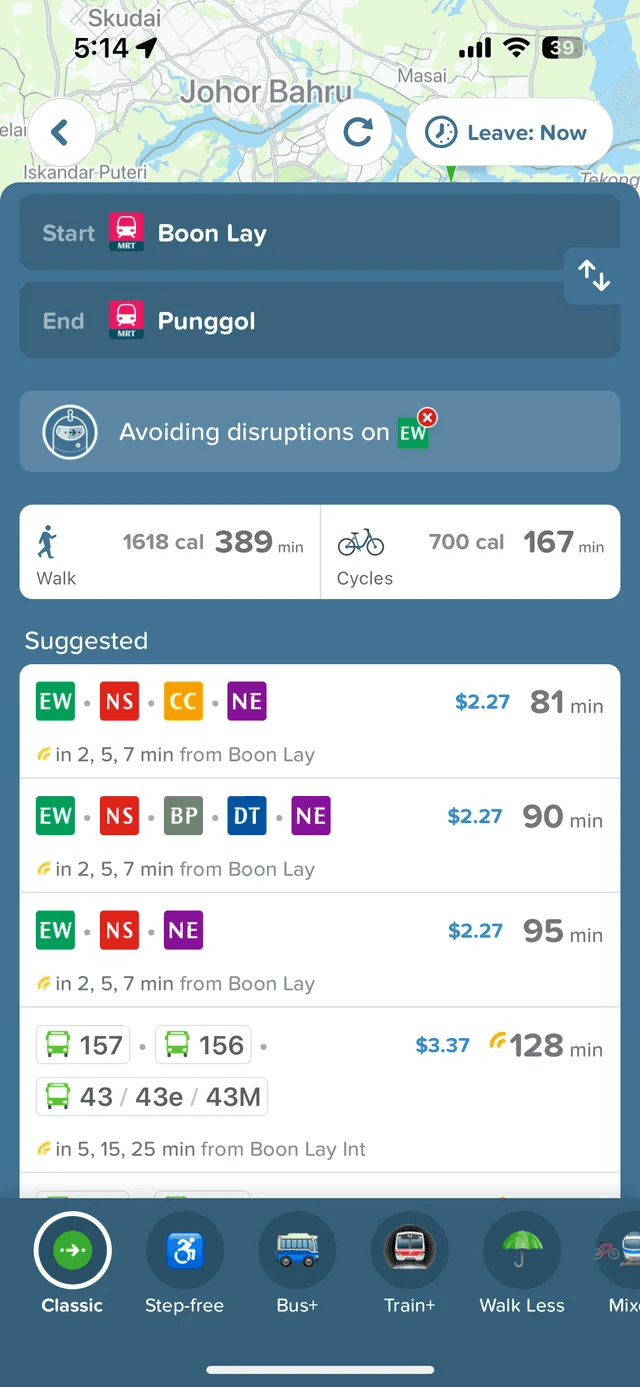
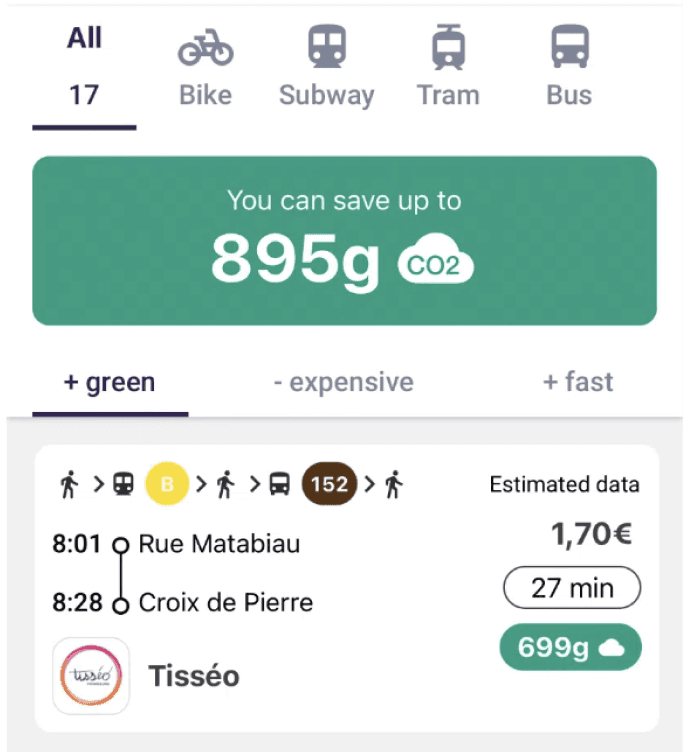
Citymapper and Ecomode applied this by showing cost and CO₂ alongside time in its multimode comparison.
But existing planners treat this as information display only, not persuasion.
Anagnostopoulou et al. + EAST Framework
Insight 3
Reflecting outcomes back creates compounding behavior change.
Duolingo's streak counter builds habits by making daily progress visible.
Citymapper shows post-trip impact data (trees saved, calories, money)
But it doesn't feed it back into tomorrow's recommendation.
Bamberg, 2013 + Bissel, 2025
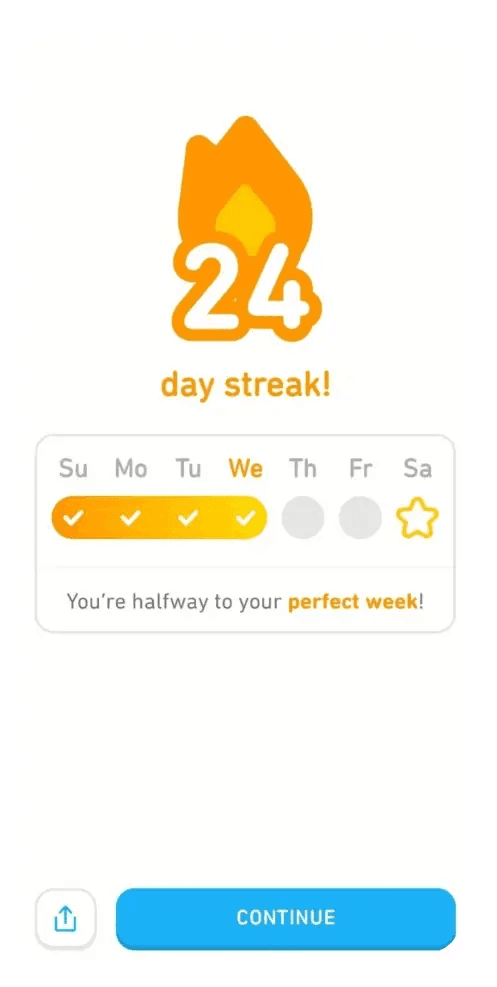
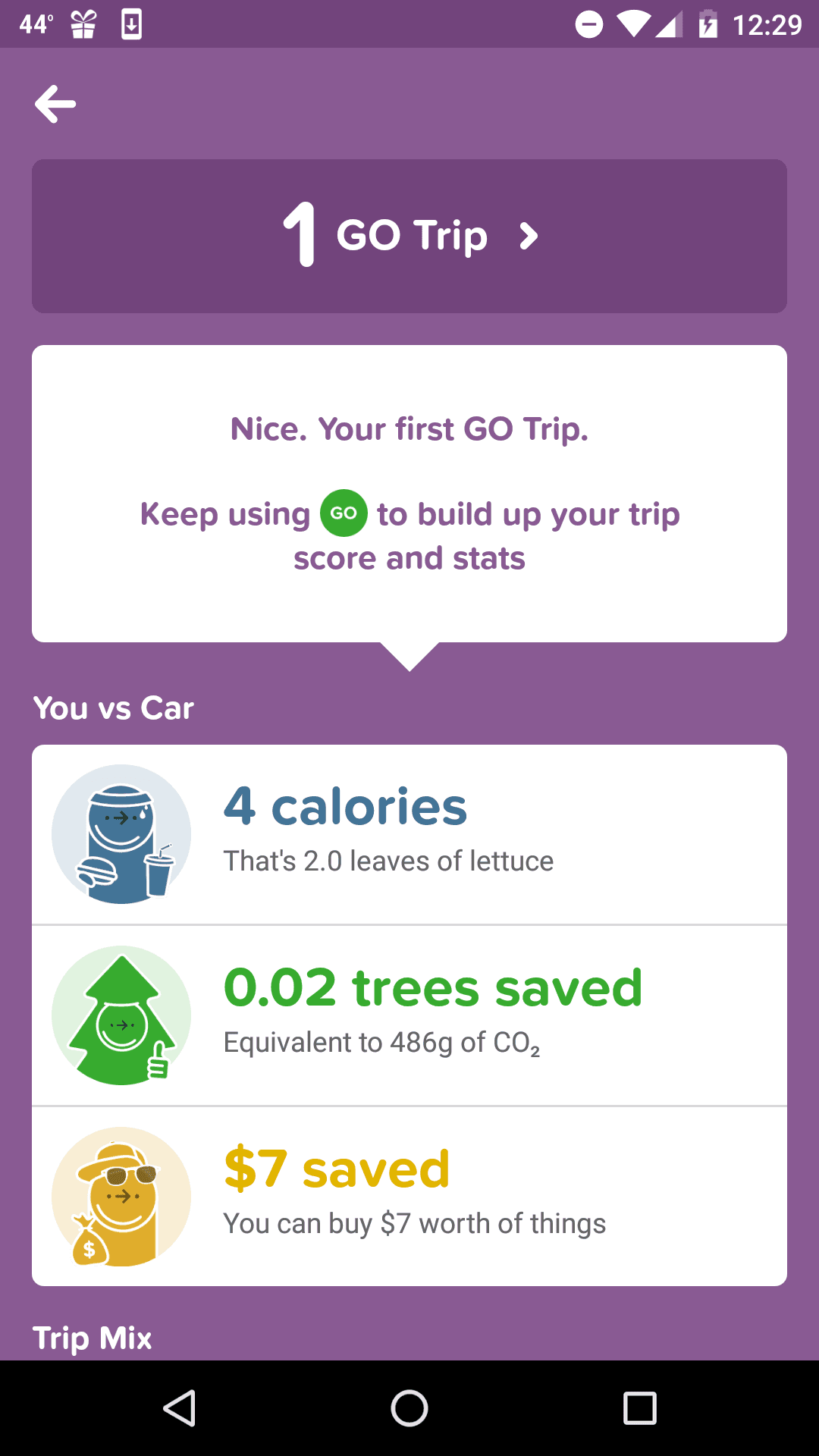
Most of the app nudges once, but none of them close the loop.
SYNTHESIZE
What OZONE needs to become
From the context, my job was clear:
Turn Nippon Koei's winning proposal into a behavioral system
Design a journey planner that doesn’t just show routes, but nudges drivers toward more sustainable choices by shaping the decision at the right moments.
And from the research, OZONE needs to:
Surface the better default
Intervene before route search begins, so the sustainable option appears as the starting point rather than an alternative.
Reframe the trade-off
Present time, cost, CO₂, and effort in a way that makes the better choice feel like a gain, not a sacrifice.
Feed the next decision
Turn each trip into visible feedback that improves tomorrow’s recommendation and helps the system get smarter over time.
Design approach
The Commute Loop Framework
I built a framework around its needs and the commuting journey itself. OZONE couldn't behave like a conventional journey planner. It needed to work as a loop, reaching drivers before they commit, while they compare options, and after the trip ends.
Each trip reinforces the next; defaults get smarter, the sustainable option keeps getting easier.
A 3-stage behavioral nudge system
Travel
Feed the next decision
Open planner
Compare
Make the trade-off legible
Plan the commute
Reflect
Reflect on trip
Loop Closes, habit formed
Start
Surface the better default
Plan the commute
Opportunity
[↑] OZONE's commute loop framework
The three stages translate into three distinct moments in the app — each one designed around a specific behavioral nudge.
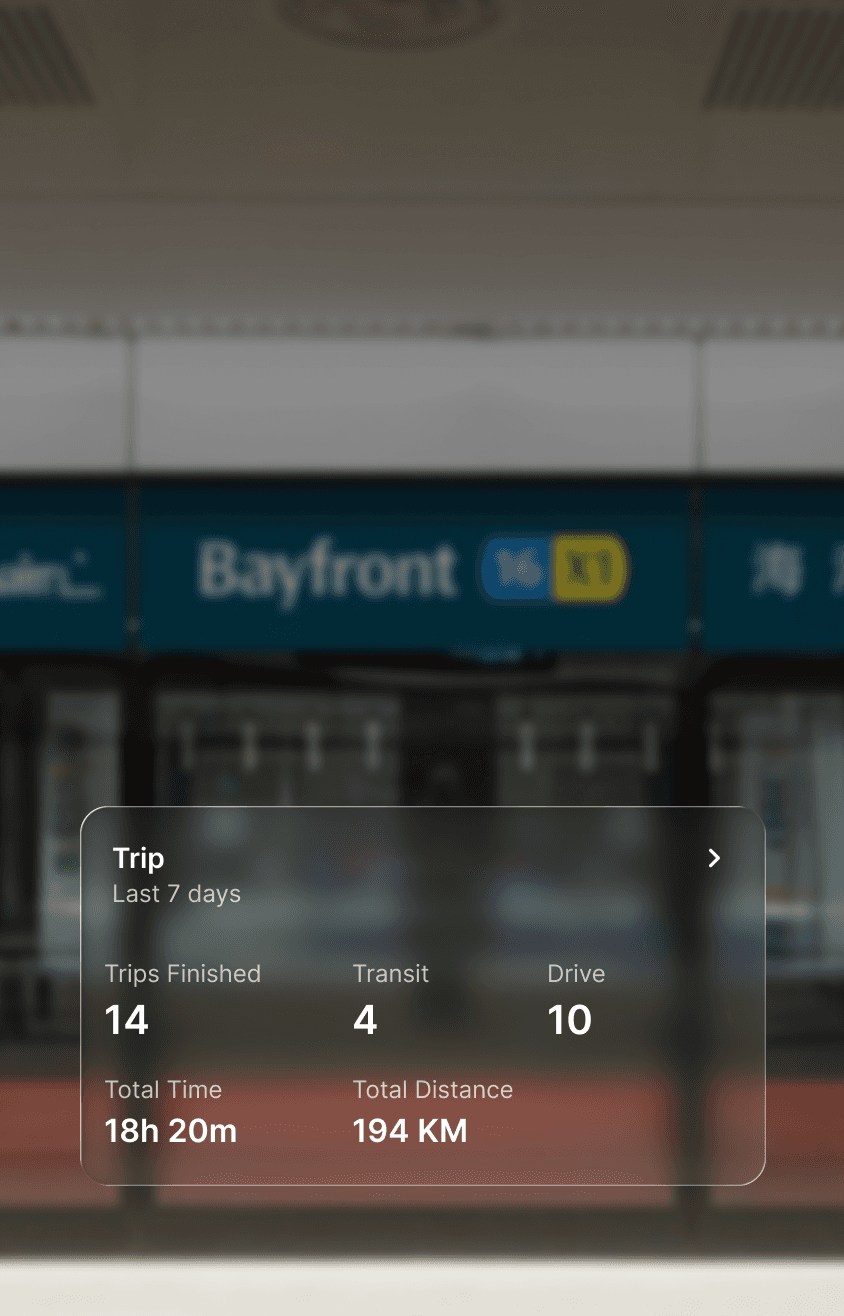
Trip
Share
In March, you have finished
55
trips
February: 46 trips
15%
22
Transit
23
Drive
Traffic Delay
Last 7 days
30
min lost
Averaged 10 mins late
Active
Last 7 days
100
Cal. burned
Today
M
T
W
T
F
S
S
Cost
Last 7 days
$3.25
Saved
Today
M
T
W
T
F
S
S
Green
You’ve saved an averaged 0,03 Trees/600gr of CO2 over the last 7 days
M
T
W
T
F
S
S
600
gr CO2
Average
Walking or taking a bike can reduce your carbon emission that impacted the environment
Start
Compare
Reflect
35 min
40 min
⛅️️
29°
9:41
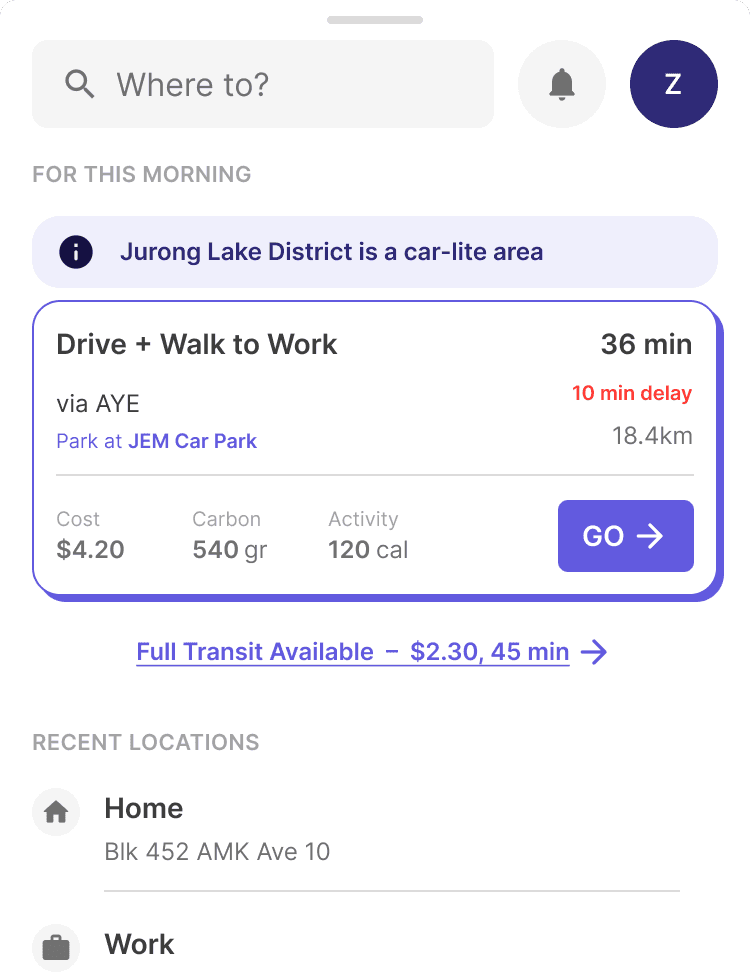

Surfaces a personalised commute recommendation before the driver searches. The homepage becomes the nudge.
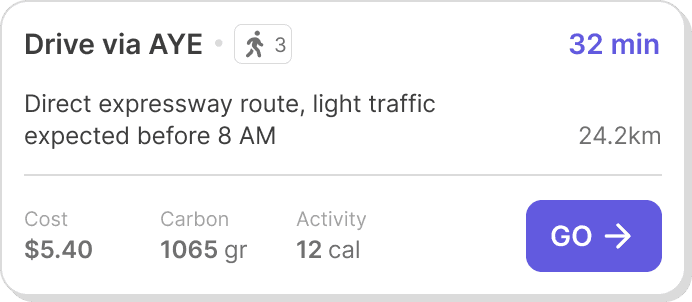
Drive via AYE
•
3
Direct expressway route, light traffic expected before 8 AM
32 min
24.2km
Cost
$5.40
Carbon
1065
gr
Activity
12
cal
GO

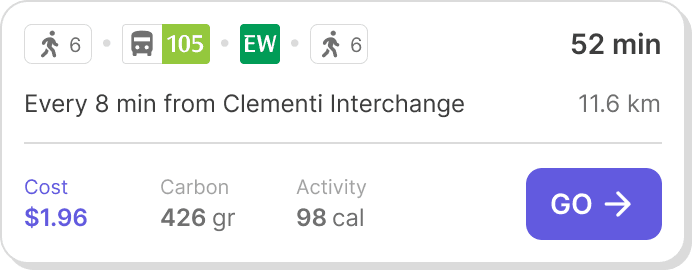
You’ll save up to $2.30 with Bus and MRT
Takes a slightly longer way but avoids tolls and high fuel zones.

Cuts CO₂ by 0.4 kg
Equivalent to saving ~1 tree a month
6
•
105
•
EW
•
6
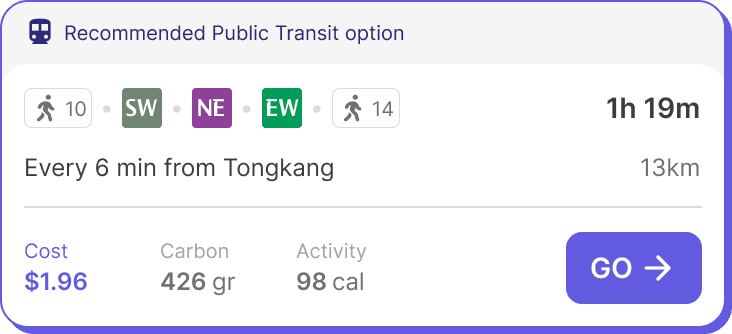
Every 8 min from Clementi Interchange
52 min
11.6 km
Cost
$1.96
Carbon
426
gr
Activity
98
cal
GO
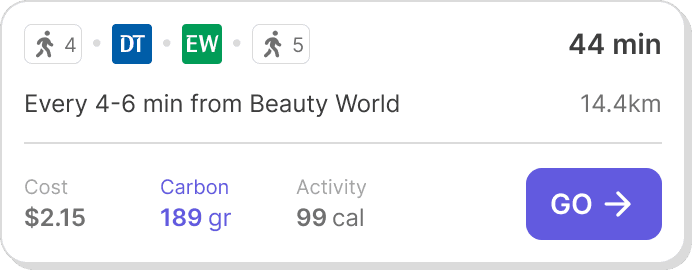
4
•
DT
•
EW
•
5
Every 4-6 min from Beauty World
44 min
14.4km
Cost
$2.15
Carbon
189
gr
Activity
99
cal
GO

Takes you ~800 steps with this choice
40% closer to reach your daily steps goal
Stage 1 - START
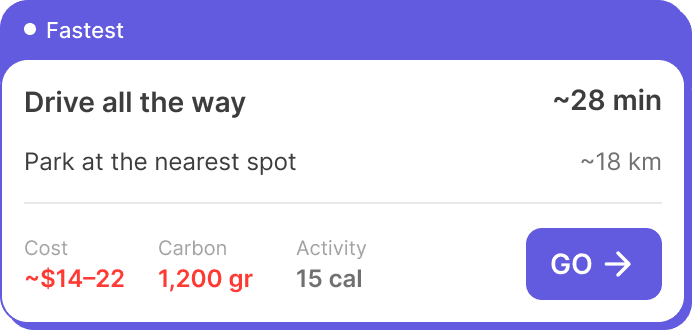
We're going to follow Zhi Min's journey using OZONE, he is a habitual driver from Toa Payoh. In OZONE's onboarding, he picked cost and carbon as what he cares about, but by default, he drives. This morning he has a meeting at International Business Park in JLD. He opens OZONE and provided with recommendations already shaped for today's context.
OZONE surfaces a route option that nudges toward a better default for today’s conditions. The three cases below show what that looks like.


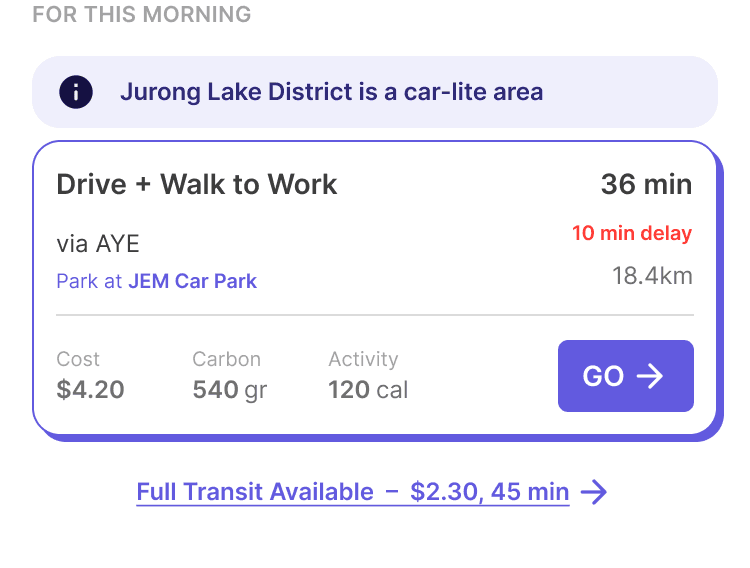
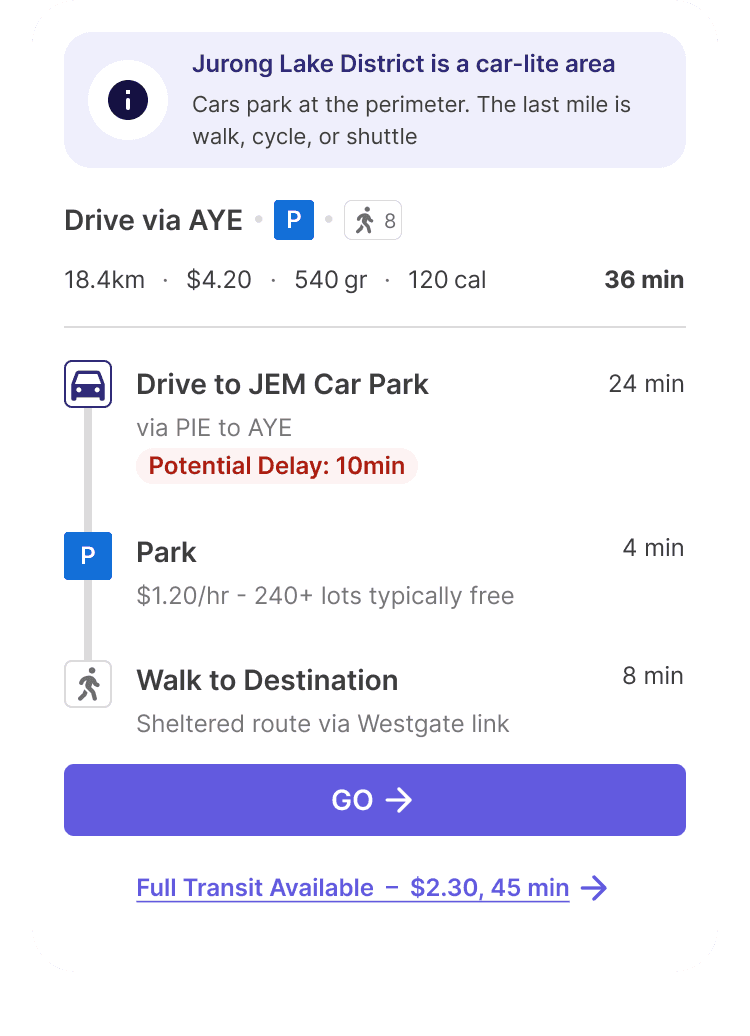
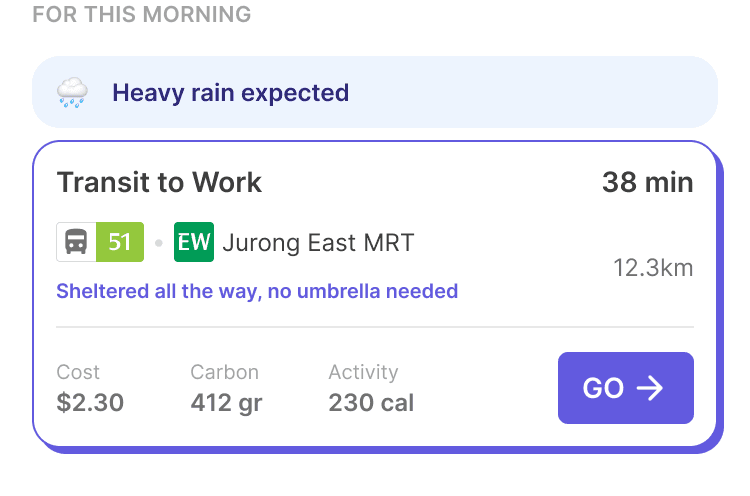
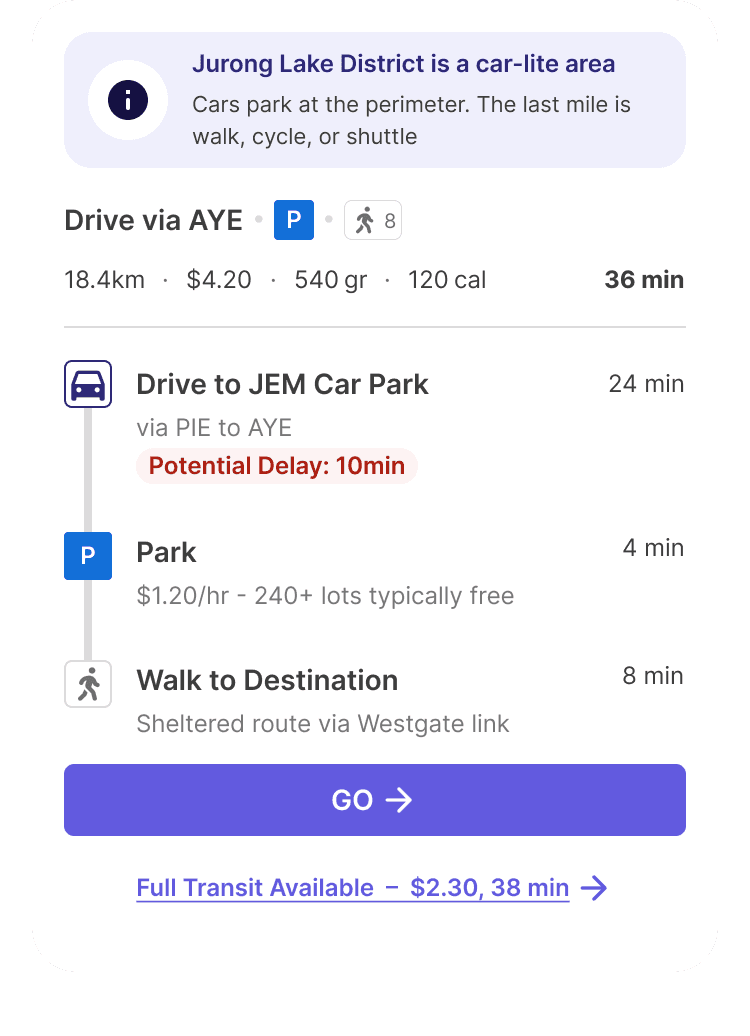
Without OZONE, Zhi Min would drive all the way into JLD, but with this nudge in a form of homepage card, it breaks that pattern. The system tries to to shift that behavior gradually through Drive+Walk recommendation, not overnight. Over time, as Zhi Min gets comfortable with car-lite commuting, OZONE can recommend full transit on daily basis.
This card does three things no existing journey planner does.
Proactive: the recommendation was waiting, not searched,
Contextual: weather, zone constraints, and service status all shape what appears on screen,
Transparent: shows spectrum of options, along with the trade offs, and let the numbers make the case.
Stage 2 - COMPARe
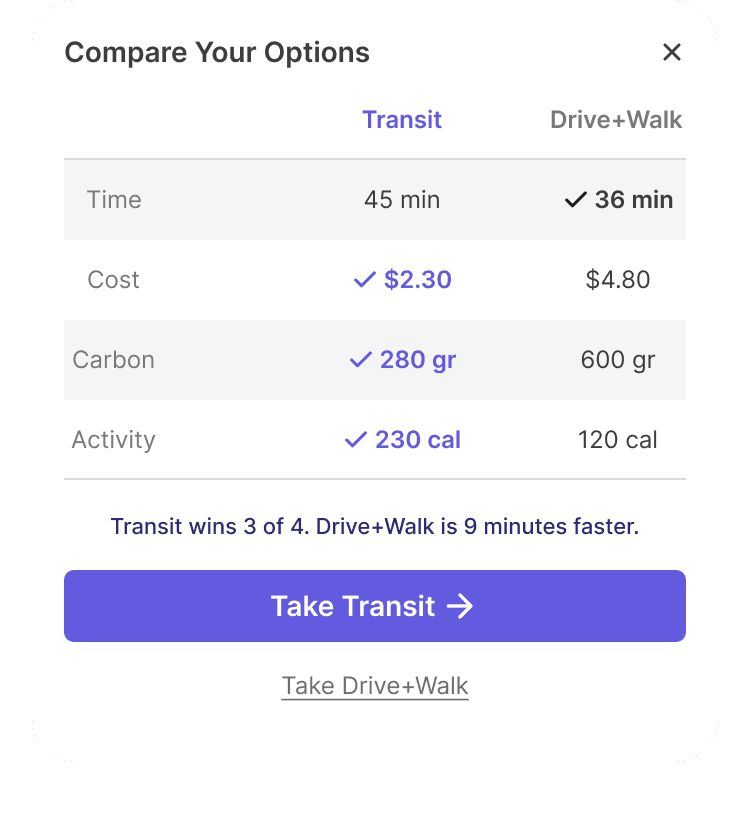
Make the trade-off legible
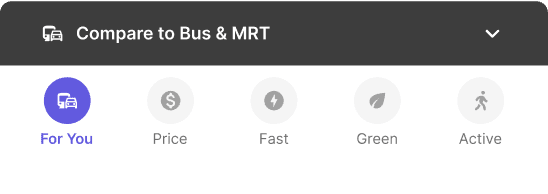
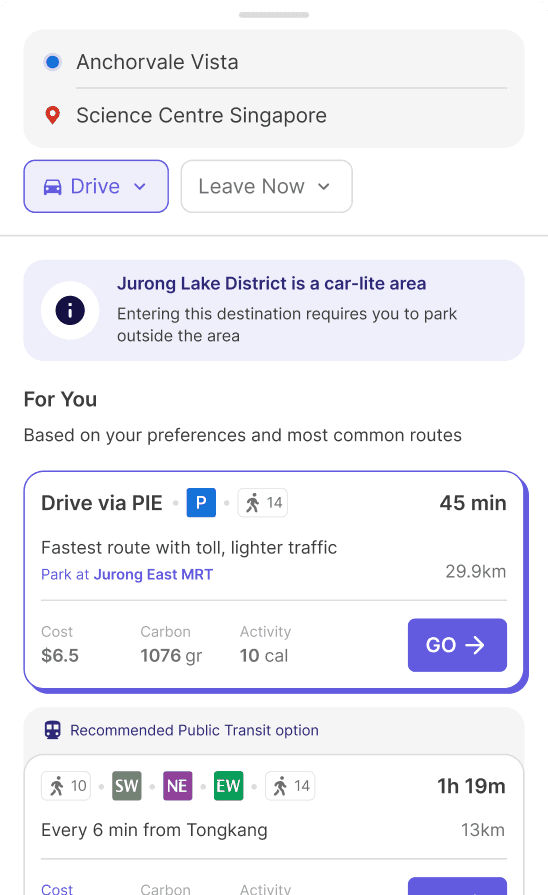
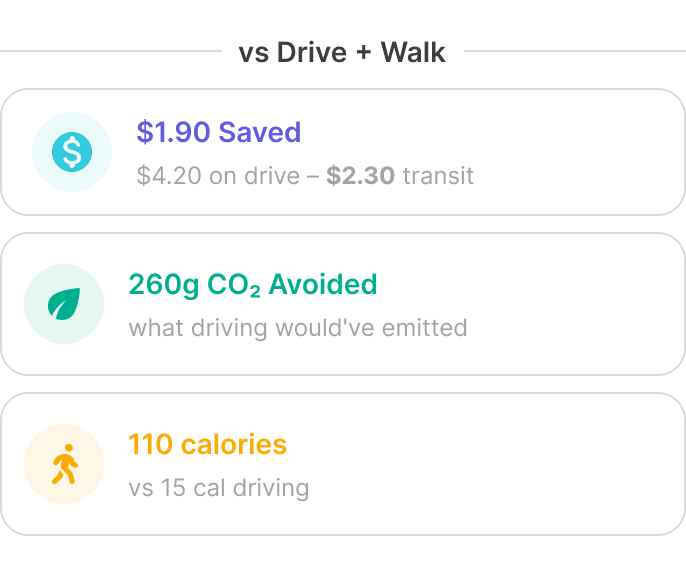
Zhi Min hasn't committed to either options yet. He taps on "Full Transit Available" and OZONE opens up the detailed comparison page. Here the all trade-off feels more concrete and personal through nudge cards that translate what the choice actually costs.


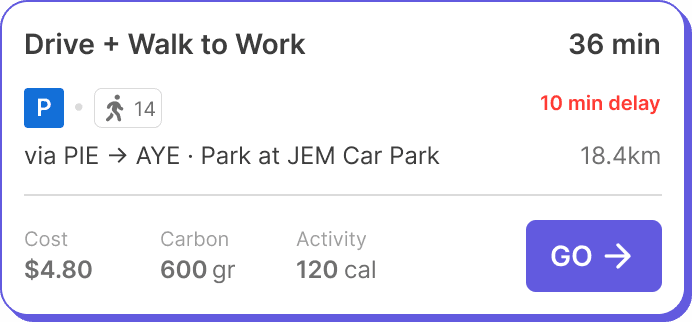
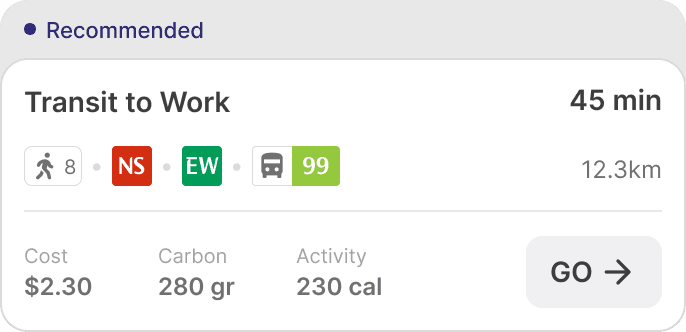

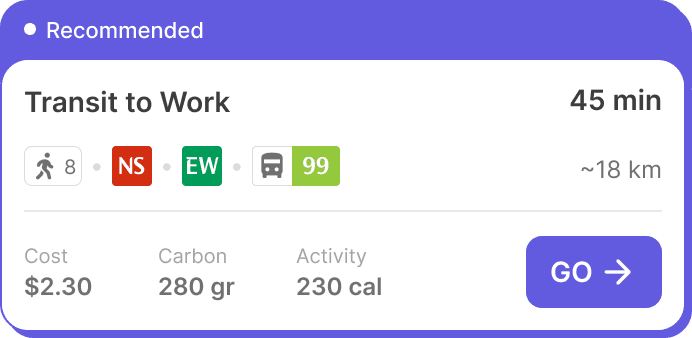
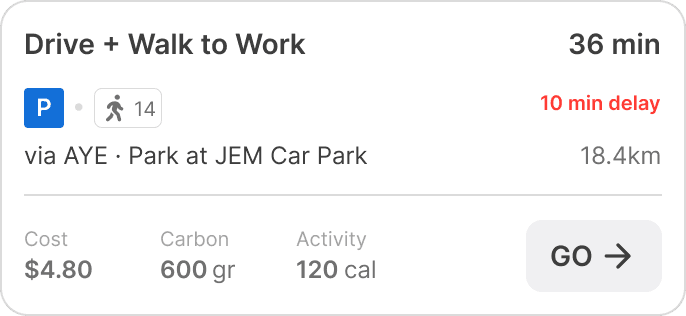


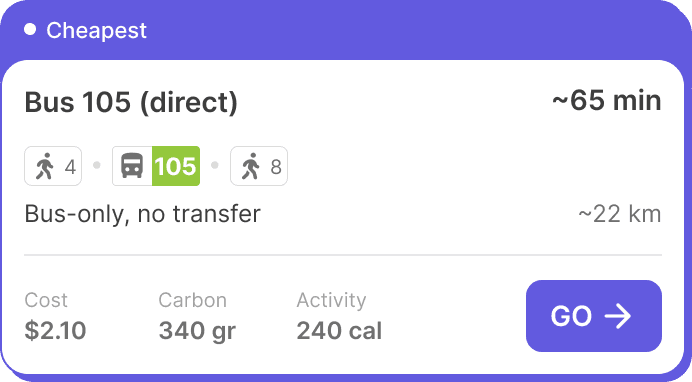
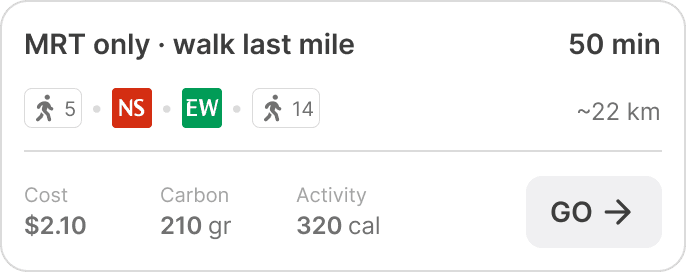
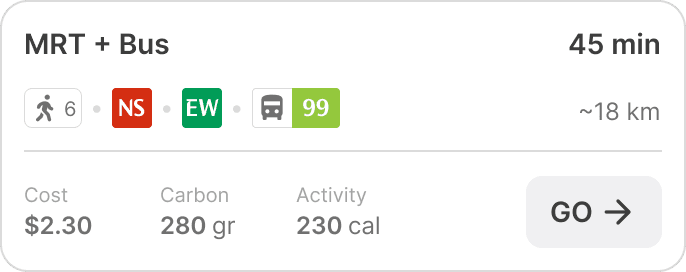





OZONE does not restrict choices but makes the better one easier to see and framed as a values decision instead of just a routing query, and that's how the nudge meant to work as a system.
For a habitual driver with good intentions, this reframing is important to make sustainable commuting feels like the easier choice instead of the heavier one.
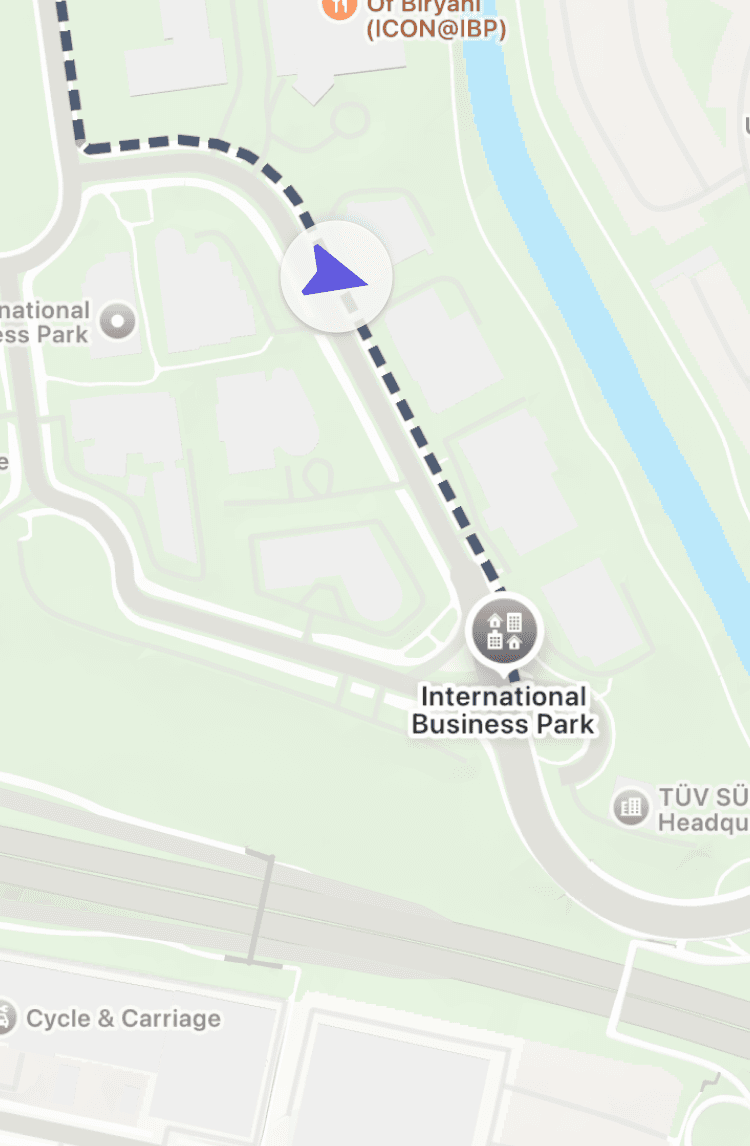

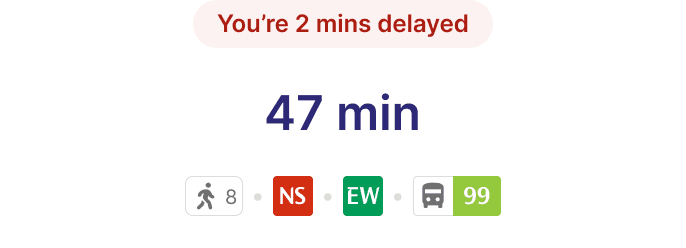
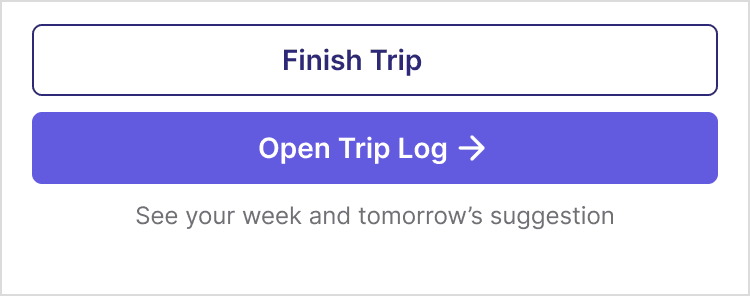

Zhi Min uses Transit to Work, and approaching his destination
This is what greets Zhi Min at his destination. OZONE measured his trip and gives him proof that he's making the better choice, Transit over Drive — mirrored back in cost, carbon, and calories as the measured impact. Nothing here pushes him further, but to see more, he can tap Open Trip Log.
Stage 3 - REFLECT
Turn today's trip into tomorrow's nudge
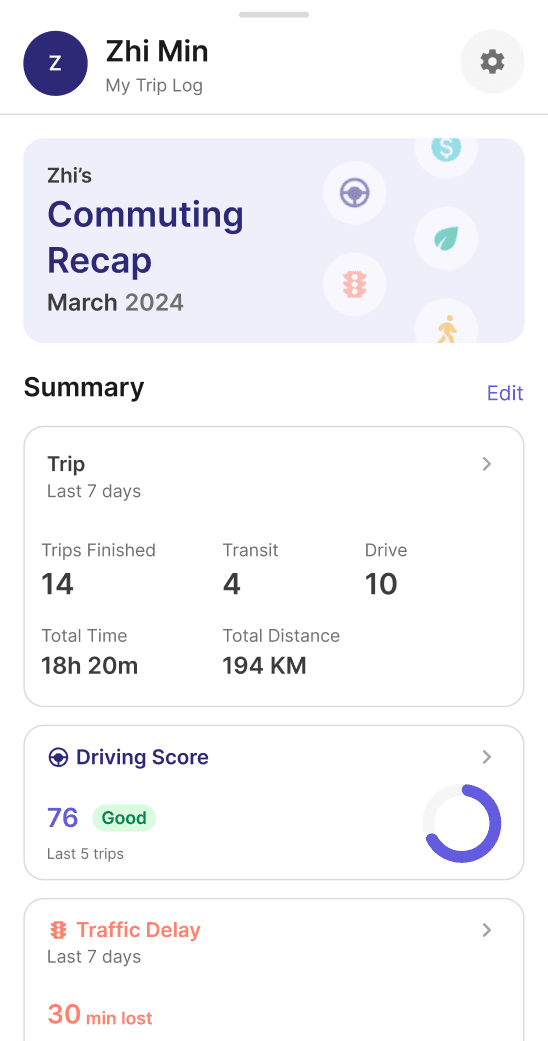
Zhi Min taps Open Trip Log. The post-trip card expands into the Trip Log — same numbers, now living somewhere they can compound.
This is where reflection turns into pattern. One trip becomes a data point; a week of trips becomes a story. The Trip Log holds both.
35 min
40 min


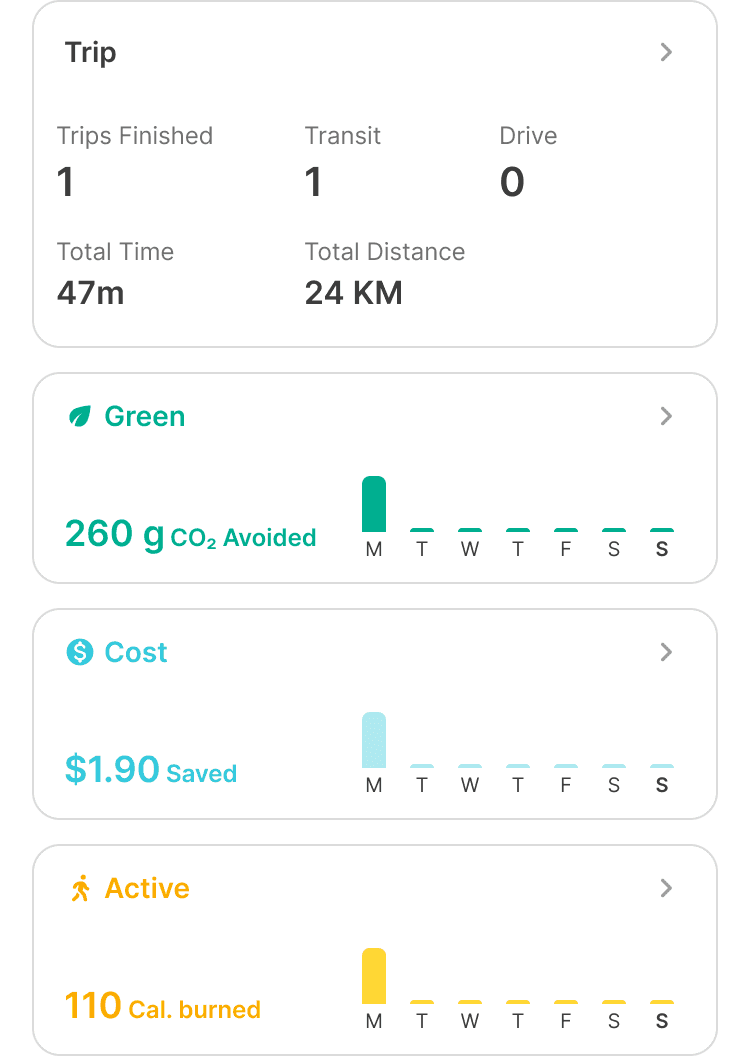

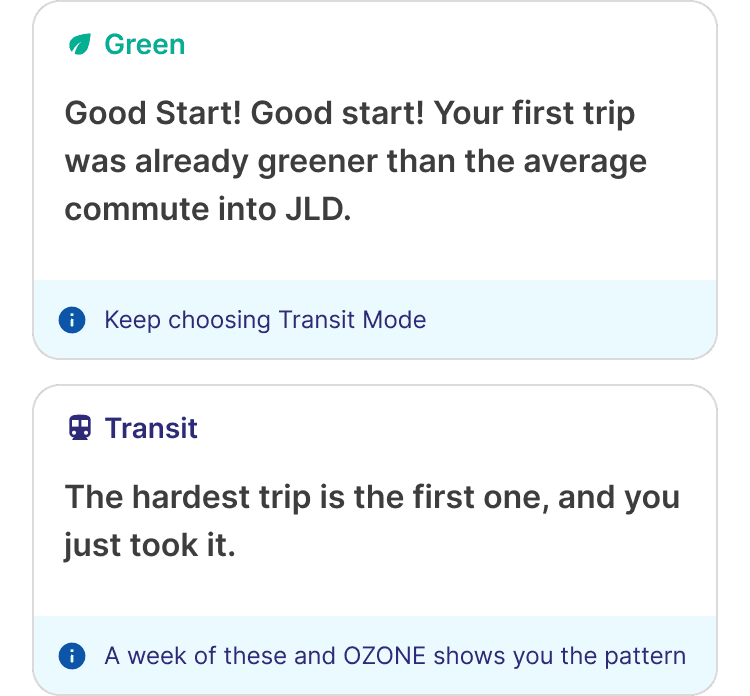
After 1 Trip
After 7 Days
Insights
Actionable tips, derived from that data — what to keep up, and the next car-lite move.
Summary
A past trip's quantified metrics — distance, cost, carbon, calories, even how he drove.
Look back to all the activities
OZONE does not restrict choices but makes the better one easier to see and framed as a values decision instead of just a routing query, and that's how the nudge meant to work as a system.
For a habitual driver with good intentions, this reframing is important to make sustainable commuting feels like the easier choice instead of the heavier one.
OZONE does not restrict choices but makes the better one easier to see and framed as a values decision instead of just a routing query, and that's how the nudge meant to work as a system.
For a habitual driver with good intentions, this reframing is important to make sustainable commuting feels like the easier choice instead of the heavier one.
Weekend Recommendation: Explore with a Guided Walk
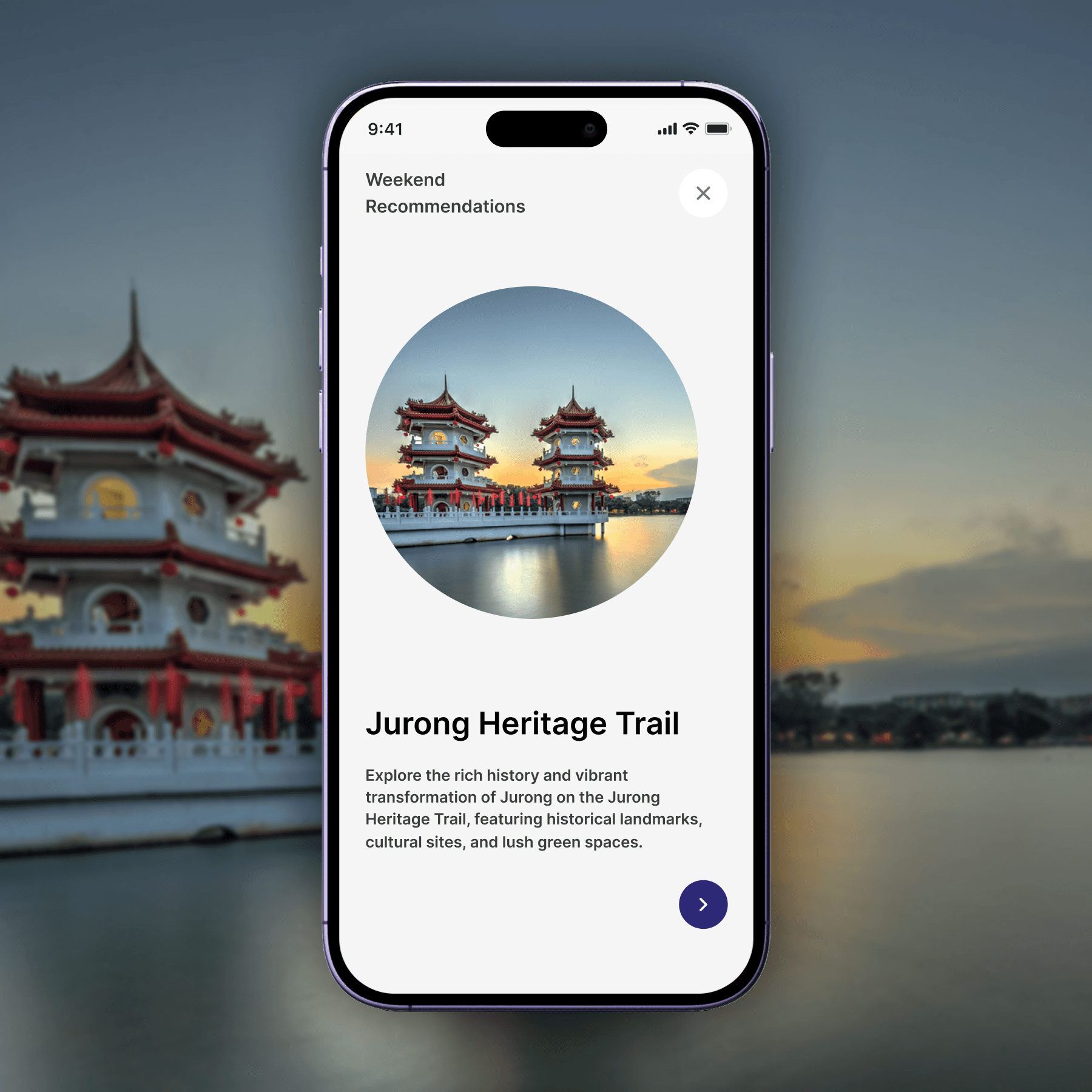
To nudge users further toward car-lite lifestyles, OZONE introduces Weekend Recommendations, designed to encourage exploration without private vehicles. These appear directly on the homepage during weekends, promoting activities like walking.
As a proof of concept, I integrated the Jurong Heritage Trail, one of Singapore’s official walking trails. I mocked up its route, checkpoints, and points of interest into a seamless, self-guided walking experience within the app. Users can follow the trail from point to point, with contextual information and visual cues that make the walk feel purposeful and informative.
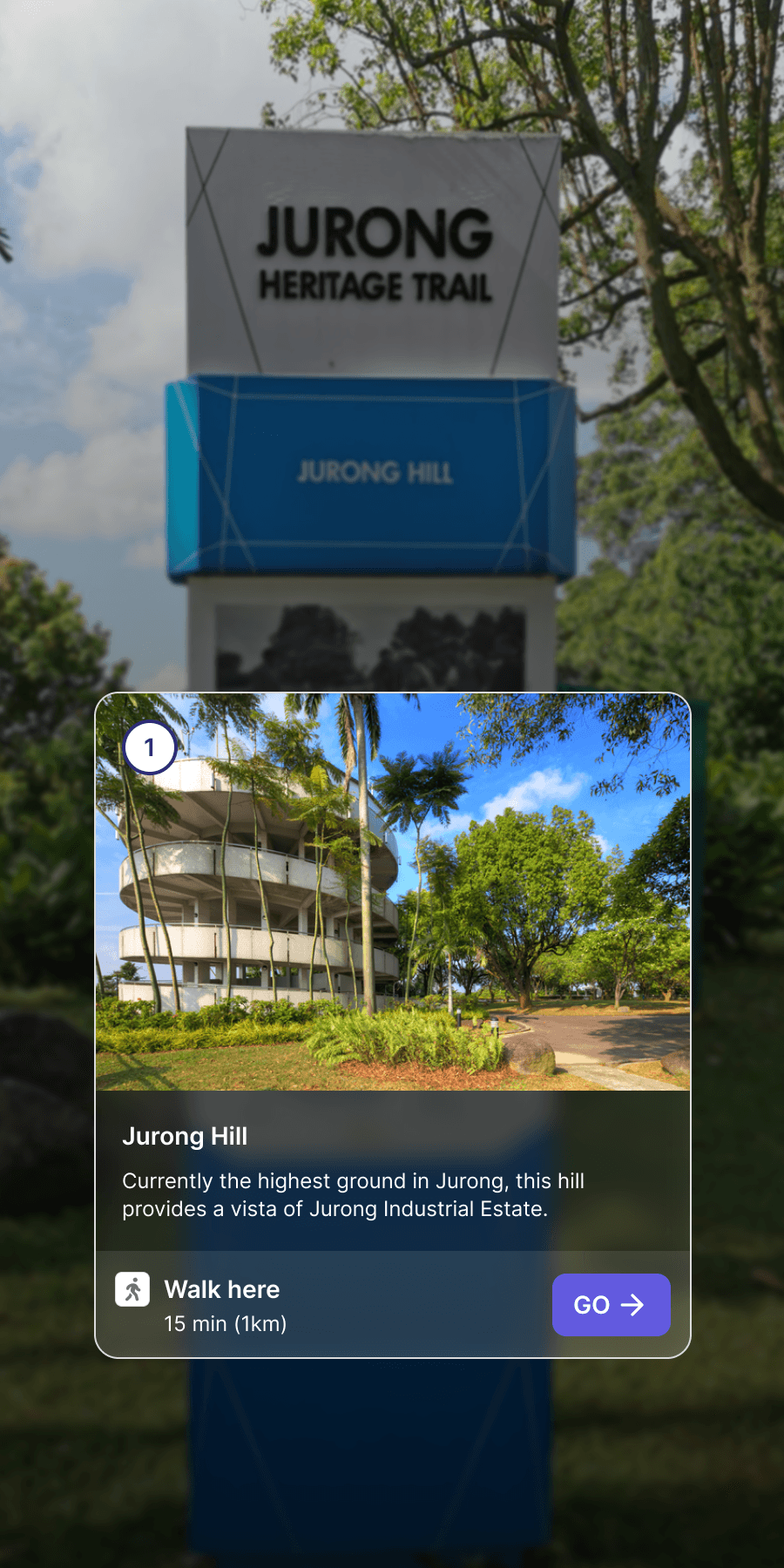
[↑] OZONE's Weekend Recommendations
Nudge users to walk through Singapore's official trails
DESIGN
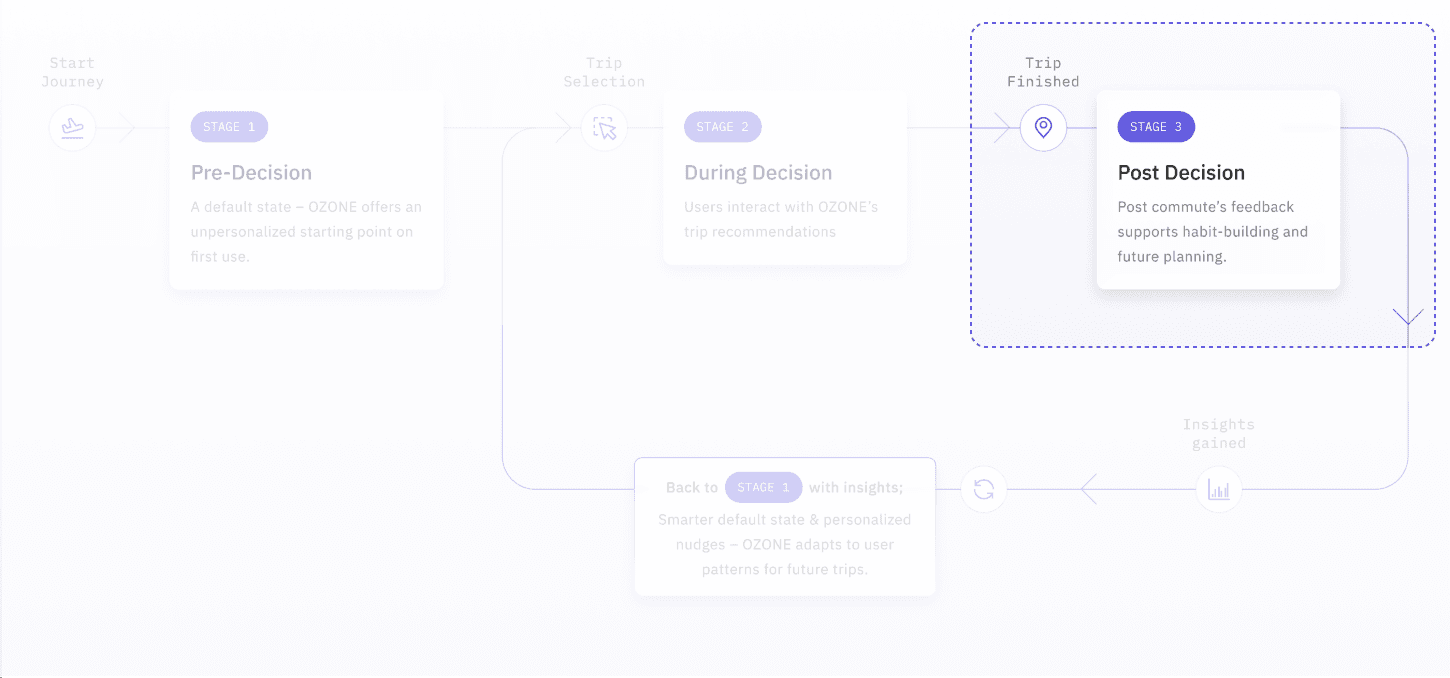
Reflect & Reinforce
Once users finished trips and continue to engage with OZONE, they begin to see the impact of their commuting behavior reflected back through visualized data in Stage 3. This stage is represented through the Trip Log page, supported with more pages that shows detailed breakdown of each data.
I designed framework that served for OZONE and NK to be able to reuse the component so it could accommodate future cases and different type of data, without tweaking the overall UI.
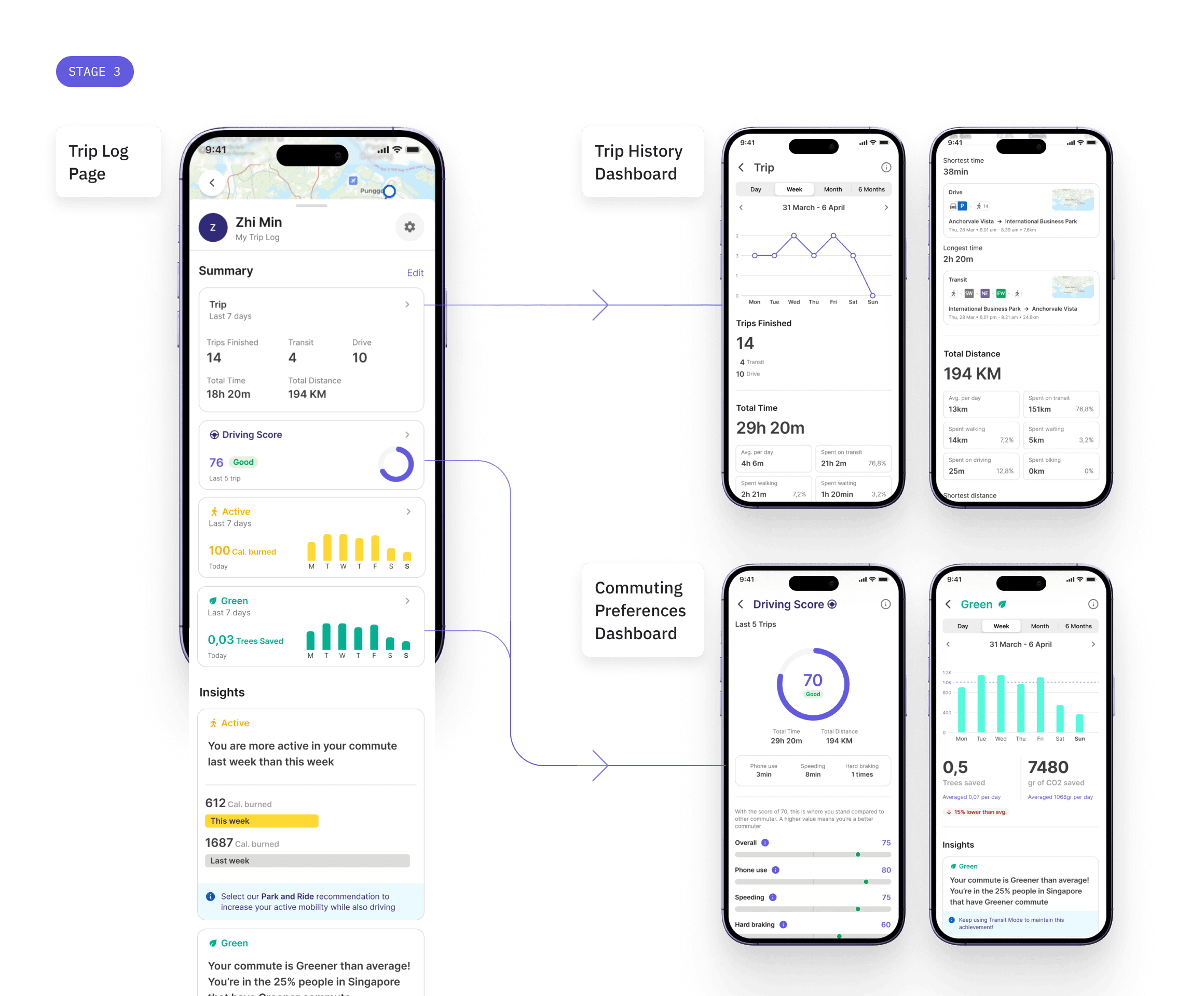
[↑] OZONE stage 3's page structure
Origanizing Summary, Insights and Preferences Dashboard into scalable visual system
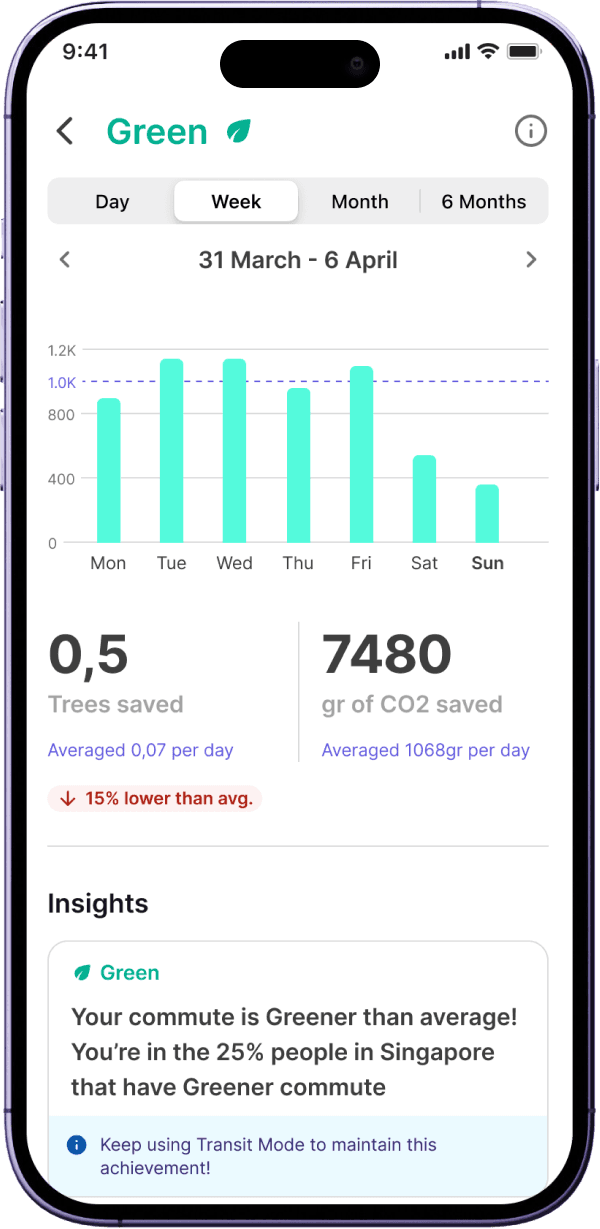
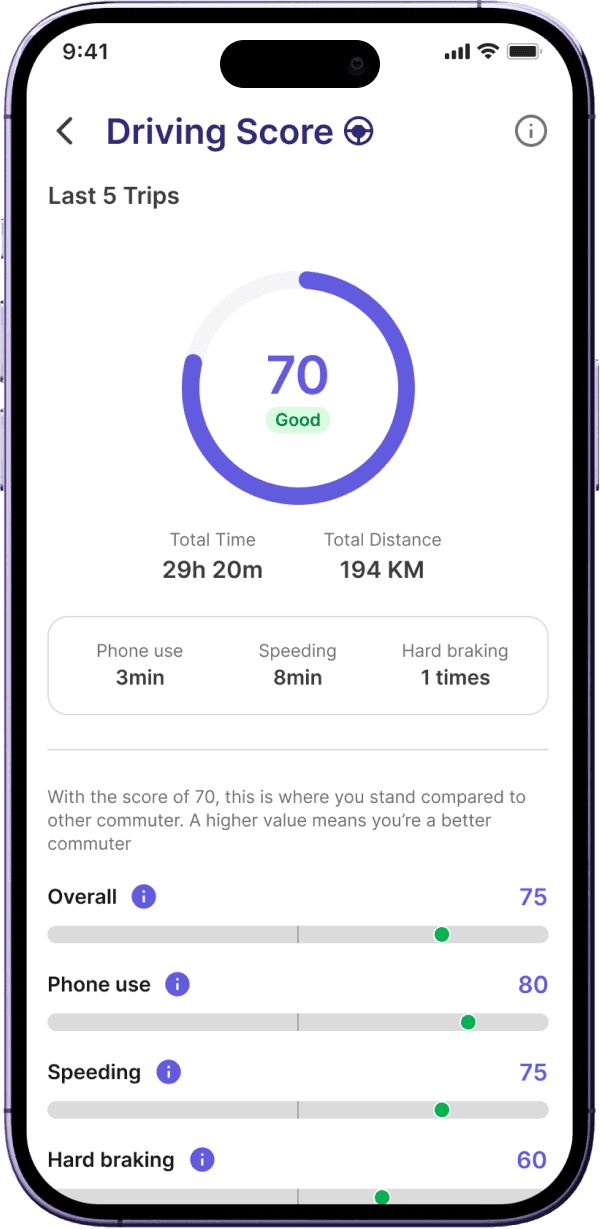
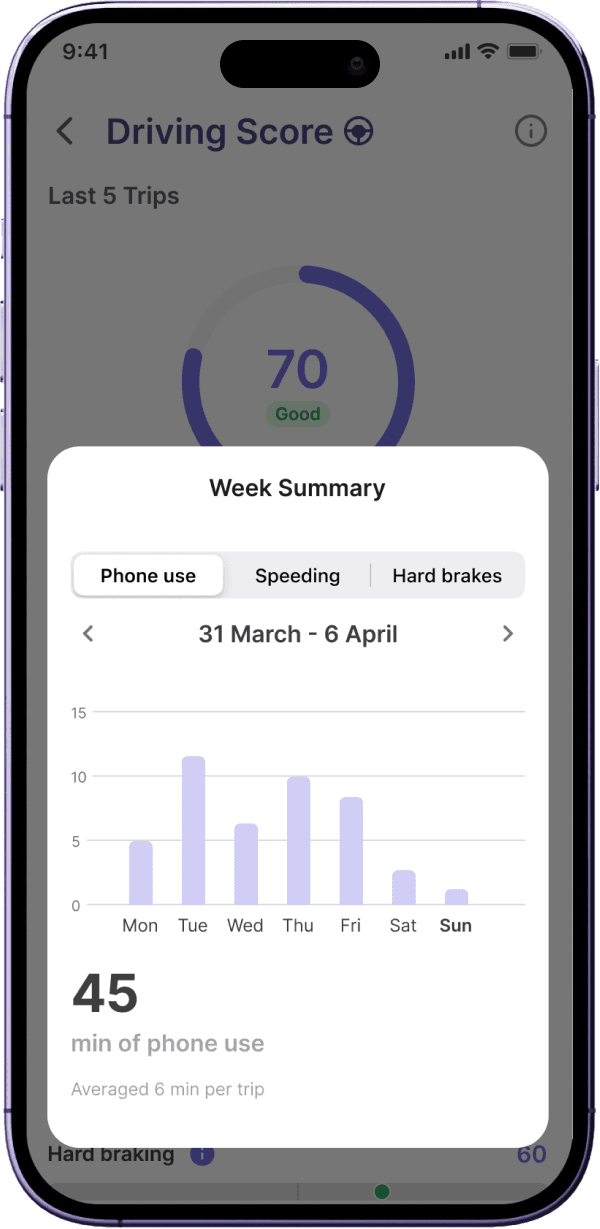
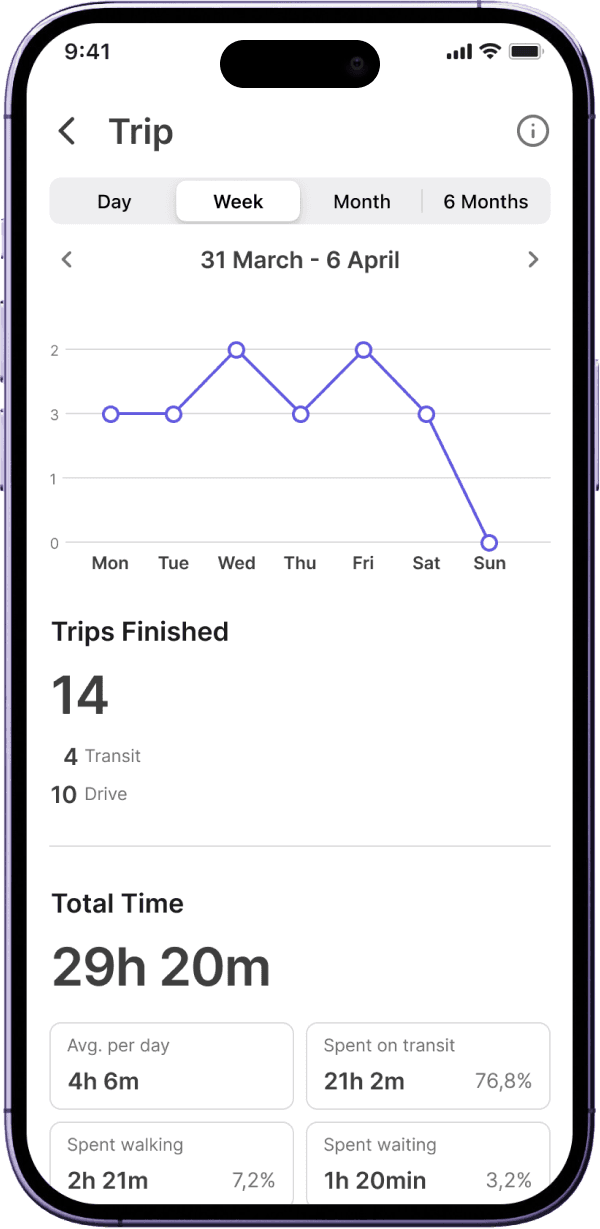
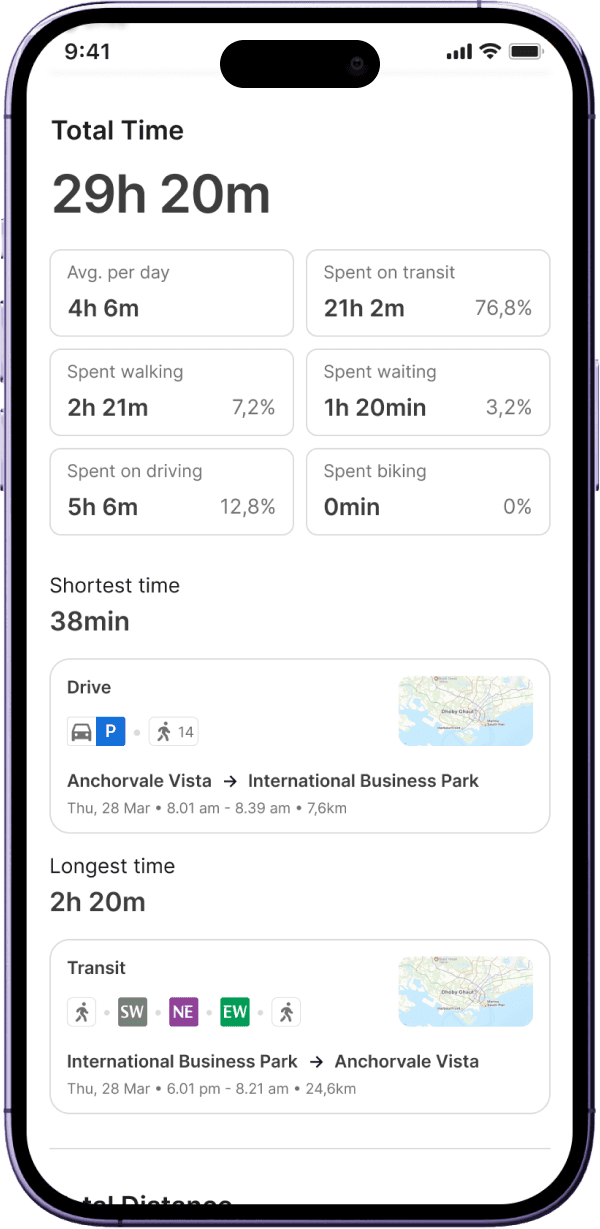
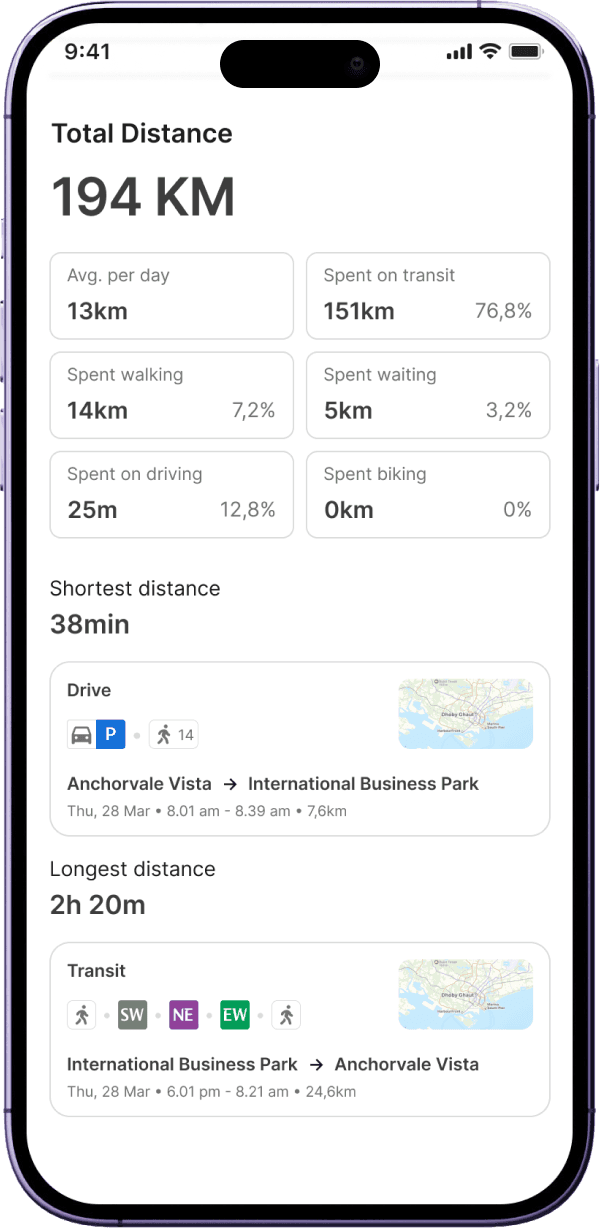

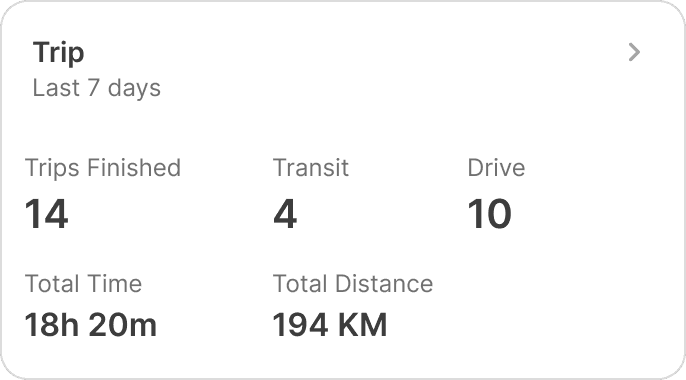
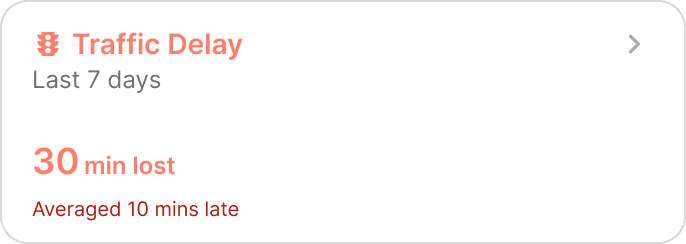
[↑] OZONE's Stage 3; Trip Log
Summary and Insights designed and streamlined to works as a tool to reinforce behavior
DESIGN
Smarter Default
Stage 3 turns trips into insights; Stage 1 turns those insights into timely defaults and notifications. The loop closes as OZONE updates the home screen and nudges with context so the next commute starts smarter.
From the stage 3, OZONE could gather insights and information to contextually nudge user
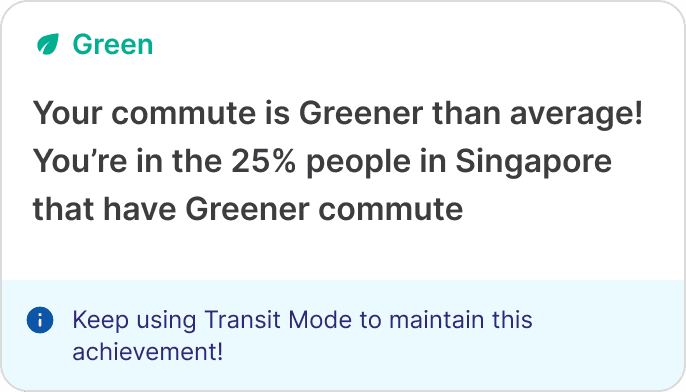
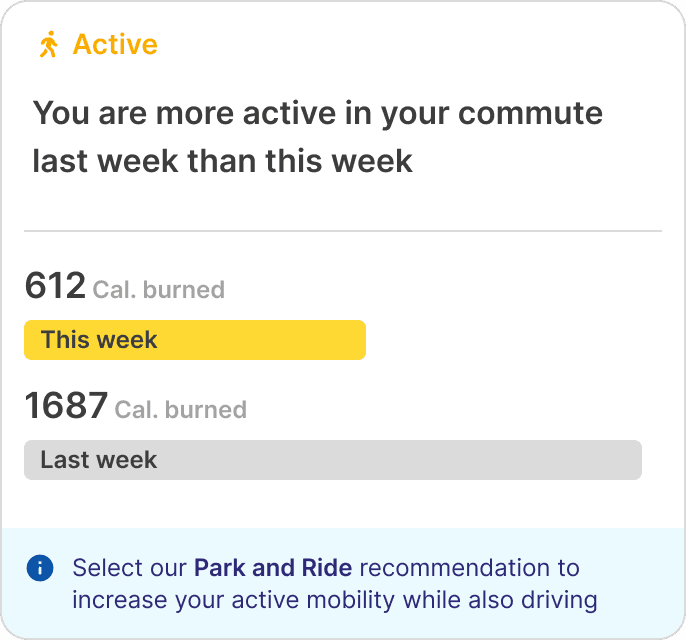
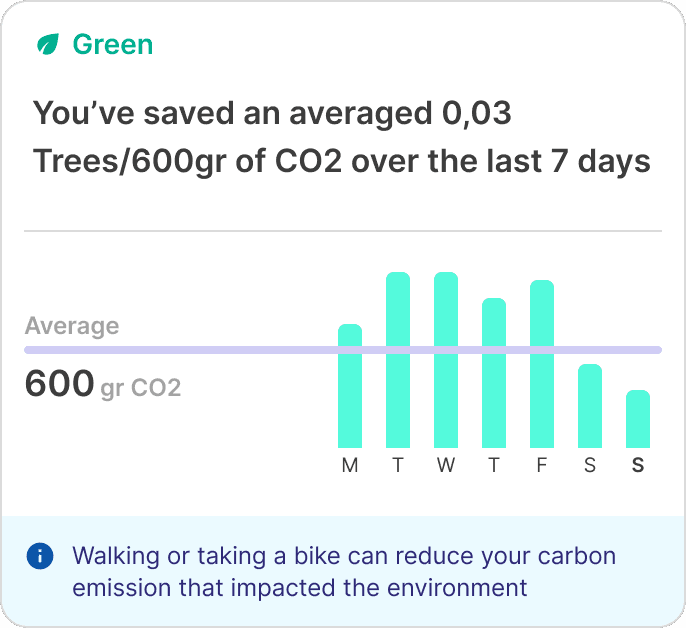
OZONE Nudge through push notification
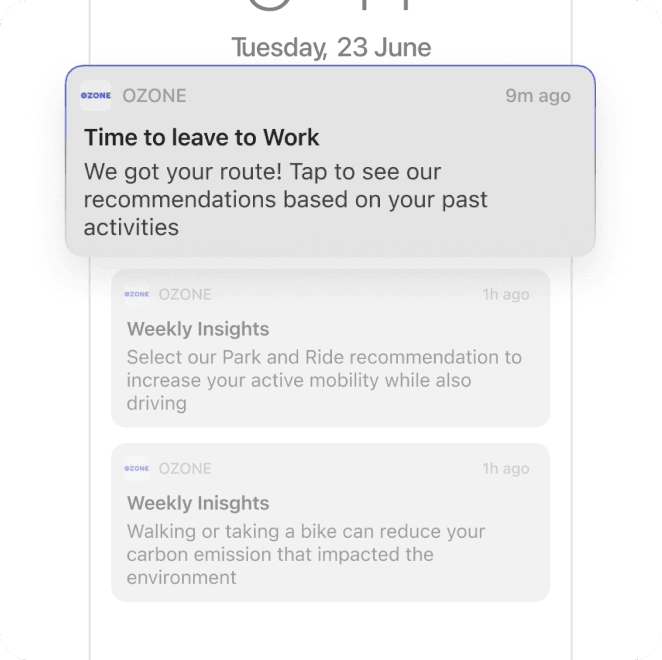
Users provided a recommendations that is timely and contextually suitable based on their habit and preferences
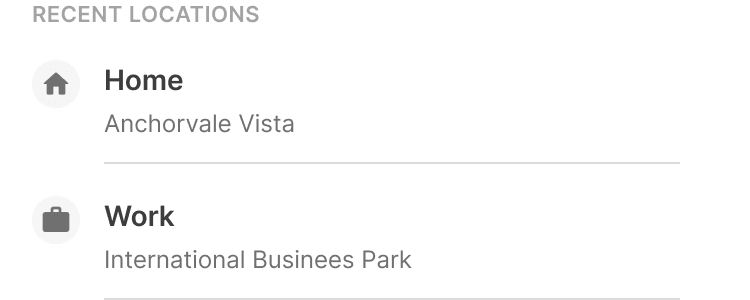
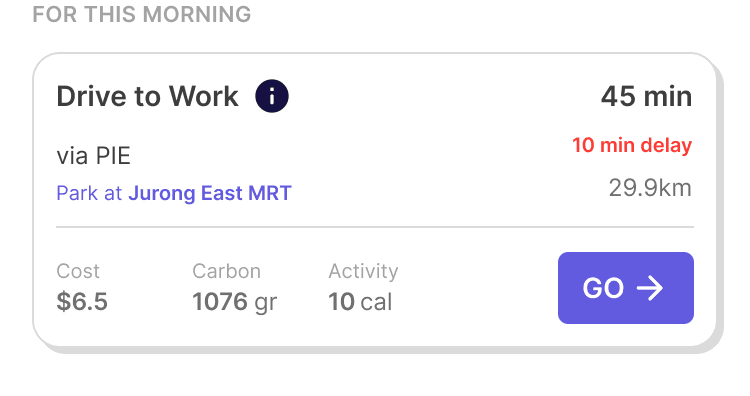
[↑] Back to Stage 1
Stage 3 insights trigger timely push notifications that reopen Stage 1 with smarter default
CLOSURE
After hand-off, OZONE moved from a journey planner to a behavior-change system. The three-stage nudge strategy turns everyday commutes into a habit loop—prime the choice → guide the choice → reflect & reinforce → back to a smarter default.
Unfortunately, I had no visibility into NK’s internal development or timelines post-handoff. OZONE was a proof-of-concept for stakeholder demos, so public release is uncertain. The outcomes below reflect the delivered system and organizational lift, not market KPIs.
Results & Impact
Pre-/During-/Post-decision flow that closes the loop
Focusing design on measurable behavior outcomes
Annotated specs, motion/empty states, copy patterns—lower dev ambiguity and faster prototyping.
to demo with authorities and reuse in future products.
Personal Learnings
The system (3-stage framework) matters more than the UI polish
A consistent card/insight template scales faster and reduces design debt
Nudges are useful when they’re timely and contextual; cadence and copy matter.
Pair every insights/statement with evidence to build trust, clarity and drive actions
With no guaranteed launch, I optimized for scalability and handoff clarity
Danu Izra Mahendra
Info